maybe all i need is a shot in the arm
two soundtrack selections for this Dolly Parton Vaccine Dose 1 Day:
two soundtrack selections for this Dolly Parton Vaccine Dose 1 Day:
Thanks to friends sharing opportunities, I have an appointment tomorrow afternoon to get the first dose of the Moderna COVID-19 vaccine. With all the requisite hemming and hawing and ethical complications (why should I get a dose when others in so much more risk don’t seem to be able to get access?!), I am SO FORKING RELIEVED.
Now, there is a personal timeline: first shot tomorrow, second shot the day before Easter, full immunity by mid-April. The timeline means that I will get to go see the exhibit of Egyptian mummies at the North Carolina Museum of Art while they’re in town. It means that my congregation might actually be able to worship in person sometime this summer. I can visit people in the hospital again, and meet people for pastoral lunches and do my in-person job actually…IN PERSON. It means that I can go to the beach with my fully vaccinated parents to help my dad celebrate his retirement. It means so much, and all of a sudden, the SO MUCH is coming into focus.

Bringing the relief into focus also brings the grief of the last year to bear. Seeing a clear path forward gives us permission to see with clarity the path behind us, too. Given the opportunity to imagine living day to day without being focused simply on survival opens up space for all those pesky and energy-sucking emotions that we’ve put on pause all year long.
I’m not a therapist or an expert in trauma responses. There is plenty of better analysis and advice than I can give, but here’s my amateur, pastoral take: we’re going to need a lot of time and space to recover from the trauma of this year. Even more so than in the middle of the pandemic, we are going to find ourselves crushed with postponed grief and delayed trauma responses. As things begin to open up and safety feels more certain, our systems are going to take advantage of the extra brain and body space and lift up all the difficult emotions that our focused-on-survival selves didn’t have time or energy for over the last year.
I’m feeling it – as soon as I scheduled that vaccine appointment, I started crying. I have had no energy for productivity all week. I tried to set aside blocks of time this week for long-range visioning in both my jobs, but as soon as my schedule cleared and I sat down to do some planning, I started crying. All that was there, when I tried to gather my wits about me to think about the future, was grief and exhaustion – a full years’ worth.
If I am feeling this enormous weight as someone who has weathered the last year in the safety of my work-from-home, financially-resourced life, imagine the weight of those who’ve experienced compounding traumas of grief, tornadoes, evictions, job loss, exacerbated mental and physical illness, lack of running water, or daily being on the frontlines of pandemic triage. Collective grief is wild and wily, and we are in it.
So, I’m trying to slow down and make more time and space for all that overdue processing – for myself and for others. And I am trying to be mindful that everyone grieves differently, and my inclination to slow down and make space might be in direct opposition to someone else’s trauma processes of speeding up and digging in. Time to be extra gentle, I think, and extra kind.
I’m reading Drew Hart’s book, “Who Will Be a Witness: Igniting Activism for God’s Justice, Love and Deliverance.” Dr. Hart is part of the Harrisburg Church of the Brethren in Pennsylvania, and he joined the CoB’s Healing Racism initiative with a lecture and conversation last month. Click that link and listen to the lecture – you won’t be disappointed.

In his book, Hart describes a moment in college when one of his white Christian friends asked him if he would die for his country. At first, Drew didn’t understand: what do you mean? Under which circumstances? What kind of scenario are you setting up, here? But eventually, he realized that the friend was asking for an all-encompassing commitment: would you die for your country without any qualifications and for any purpose?
“My answer,” he writes, “was easy at that point – ‘Hell no!’ is probably what I said (or at least what I was thinking)…I was confused. There should never be anything that demands your ultimate allegiance as a Christian, regardless of the context and circumstances, except discipleship to the way of Jesus, yielding to the Spirit’s activity in the world, and worship of our Creator, and living life committed to loving your neighbor as yourself.” (WWBAW, p. 166)
In this morning’s devotional reading, Anna Lisa invites us into the story of Naboth and King Ahab. Ahab lusts after Naboth’s field, vowing to starve himself to death until he could get what he wanted. Ahab was KING – he had EVERYTHING. And yet he was willing to die for the next best thing that he couldn’t have. Anna Lisa says “There’s a striking correlation between lung capacity and lifespan. The clothes you wear, the way you sleep, your stress level, pollution and infections can decrease your lung capacity. Is your rush-hour commute worth dying for? What about the hours at your computer?” Her prayer at the end of the day’s reflection is “Jesus, you died for love, healing and revolution…teach me to live and die for these things, too.”
We’re all just trying to survive, right now. Avoiding death sort of seems like a wiser activity than discerning what it is we would die for. Except, for the last year, people have been making that choice over and over and over, every single day: I will die for a chance to eat in a Chili’s. I will die for my “right” not to wear a mask. I will die for one hour of sitting inside my church’s sanctuary. I will die for the honor of caring for COVID-positive patients in my workplace. I will die for money to pay the rent. I will die for a birthday party. I will die for the permission to teach my students in person. I will die to accompany my sick child to the hospital. Every one of these scenarios has come to pass over the last 12 months.
I got my hair cut yesterday, inside a salon. I’m super cautious in every other way: my only other indoor activity is a weekly grocery trip for 20 minutes or less. But a haircut – one hour every two months – means a trip downtown, an hour of conversation with my stylist who I love, a rare opportunity to experience human touch, and a tiny bit of normalcy when I look in the mirror and at my own face on those godforsaken Zoom screens every day.
I suppose, in some forms of this calculus, I have decided that I will die for a haircut. Or maybe I will die for an hour of face-to-face conversation with someone I like. Or maybe I will die for the sensation of human touch.
It’s messed up that we are forced to decide, every day – every hour – what we are willing to die for. Both Drew Hart and Anna Lisa Gross wrote those reflections before this pandemic, before the question about “for what are you willing to die” became a constant drumbeat behind each day’s to-do list. Their questions are also individual ones, but the pandemic has expanded the question to: what are you willing to kill for? Every one of these decisions has the potential to kill someone else.
I think it’s still worth asking, and answering. Am I willing to die for my hours at this computer screen? Am I willing to kill for the chance to eat mediocre food inside a restaurant? Am I willing to die for human contact? Am I willing to kill for my country?
A year ago, I would have had ready, powerful answers to all of those questions. I would have answered with clarity and hubris. “No!” I am only willing to die for love, healing and revolution. Humbling, then, to recognize how small and needy and how very much like King Ahab I am, how less-than lofty my basic requirements reveal themselves to be, how much I need other people.
I’ve hit a major wall in pandemic cooking. For a year, I’ve kept myself fed with (mostly) healthy things. The Budget Bytes website and the occasional Dinnerly meal box delivery (that link will get you a free box, on me!) have been my mainstays. I try to eat a lot of veggies, not too many carbs, less meat than plants. You know: healthy stuff.
Cooking for one is not ideal in any season. Recipes don’t make single servings – they create batches of food, which means I generally cook and eat two main meals over the course of a week. That’s a lot of leftovers, and it is usually just fine. Most of the time, I like finding interesting recipes and doing the meal planning and grocery shopping. Cooking after a day spent staring at this laptop screen feels like a great break. But the last month, all of the required time, energy and attention has mostly had me feeling like Paul Rudd (in one of the greatest scenes ever to grace a movie screen):
The kicker is, though, that there is no Janeane Garofalo in the room, or anyone else, for that matter. My entire sighing, put-upon performance is directed only at myself. There is no one else to blame, here! There is no one forcing me to cook healthy meals or clean up the kitchen when I’m done. This entire cycle of obligation/resentfulness is always and only directed at myself. Exhausting.
This week, I complained enough about having to feed myself and then resenting the fact that I have to feed myself that my friend Kendra took pity on me: “Well, why don’t you go to Aldi and just buy a week’s worth of their prepared foods. Not takeout every night, and just for one week. Maybe that will give you the break you need to get back into cooking.”
And as soon as Kendra offered that option, I felt the weight of the world lift from my shoulders. Well, of COURSE I can do that! Aldi has fun prepared foods, too: pizza and stir fry kits, barbecue trays and frozen waffles. It was like a whole new world opened in my brain. So simple. So silly.
I went to Aldi on Monday and did exactly what Kendra suggested, and the mental space that is freed up this week has been amazing. No hours spent debating what to eat for dinner. No cycles of obligation, resentfulness & guilt about the smallest, most mundane part of my day. I’m just…opening the fridge and pulling out whatever is on top of the pile.
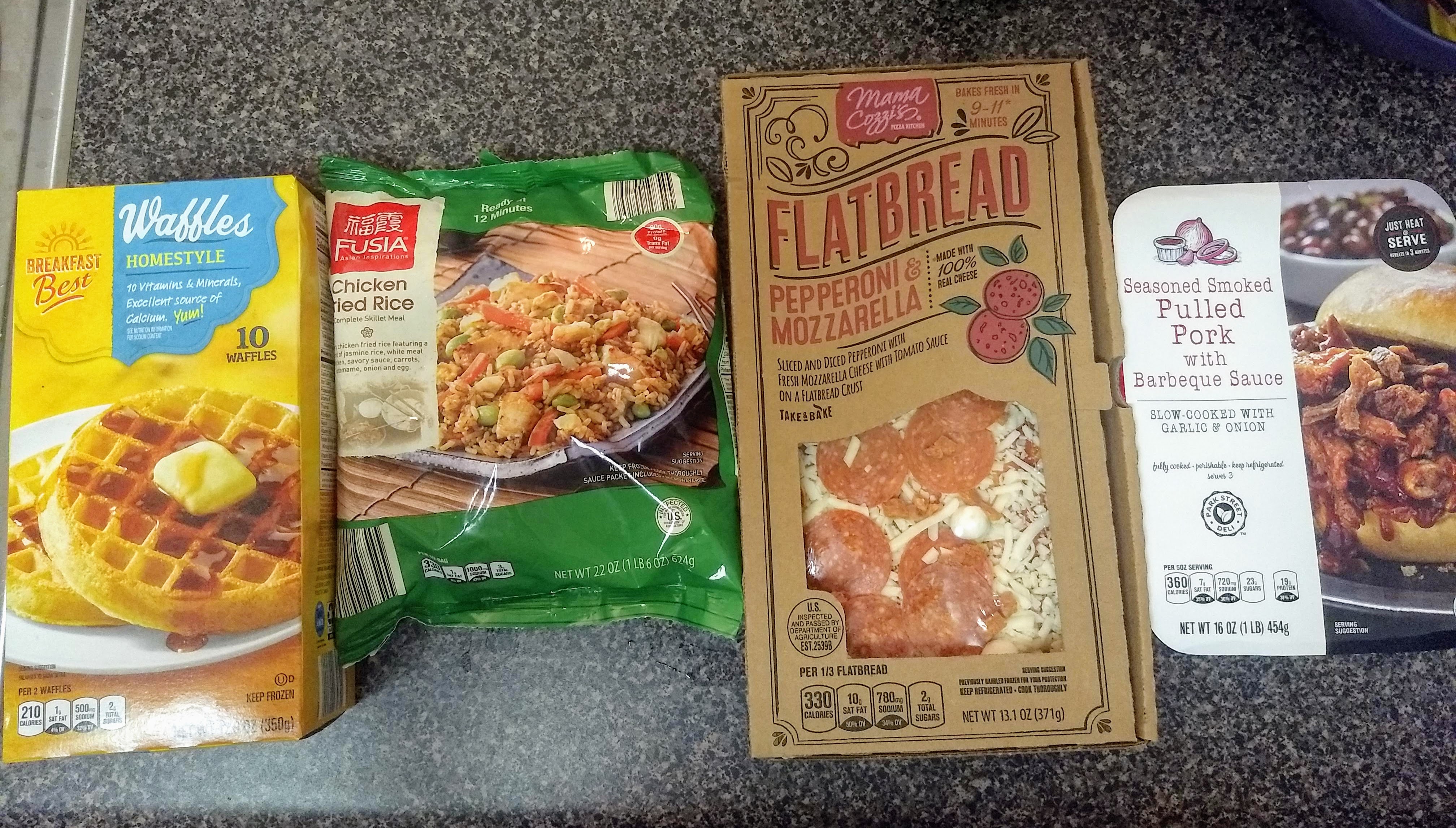
I know this probably sounds ridiculous to some of you, both the ones who eat this way all the time and the ones who are still leaning into pandemic home cooking with a vengeance. But it’s real. I had not realized, until Kendra gave me permission to stop, that I had been so obsessed over my own self-imposed obligations and so sunk into my own self-created resentfulness. “Hey,” she said, “it doesn’t have to be this way. Just choose this simple alternative. It will be okay.”
For whatever reason, I did not have the resources or wherewithal to grant myself that permission that I so desperately needed. I needed someone else to grant it for me.
So, hey: it’s the end of an entire year of living in a state of fight or flight. The losses we’ve racked up are enormous. The anxiety we’ve carried is heavy. We are anticipating another few months, at least, of this state of heightened awareness.
It’s okay to give yourself a break.
I have heard people saying that for months, now, but it never crossed my mind that it could mean buying prepared foods instead of agonizing over what to cook myself for dinner. So, I don’t know what it might mean for you, right now. But if you, like me, find yourself immobilized on the living room couch after work, perseverating on your dinner choices or your to-do list or your kids’ extracurricular schedule or WHATEVER it is that is binding you up in knots and keeping you hostage to the internal cycles of demand/anxiety/resentfulness…well, hey: it doesn’t have to be this way. Take the easy option. Take a break. Leave some things undone. If you can’t entirely relinquish that sense of responsibility or obligation to your boss or your family or yourself, at least try to loosen your grip on it a little. If you are anything like me, your body and brain and being will be so grateful for the relief.
Last summer, after some 18 months of deliberate learning and discernment, my congregation joined the Supportive Communities Network, a group of congregations and organizations who are public and clear in our affirmation of LGBTQ siblings. The process for our congregation was good and holy, and our final vote was unanimous. We were both deciding to be who we already were out loud while also submitting ourselves to a continuing journey of transformation.

Since we joined SCN, I got to participate in a series of conversations for pastors of new-ish SCN congregations earlier this year. One of the topics of conversation was the 1983 Church of the Brethren statement on Human Sexuality. This statement is now almost 40 years old, and one of the questions we wrestled with was “If the Church of the Brethren were to write a new statement on the same topic, what should it say?”
Those statements are – ideally – products of faithful communal conversation, study and discernment. But our church has systematically excluded, silenced and shut out the people to whom that statement has done the most harm. I am new to hearing the heart-rending realities of this harm, not because it wasn’t being pointed out but because my own ears were sealed up with pride and privilege and a desire to belong. People in the Church of the Brethren have been naming, identifying, lamenting, calling out and rebuking this harm for decades. I get to know and love some of them.
When someone tells us that they are hurting, we are called to weep with them. When someone tells us that WE are the ones who have hurt them, we are called to humbly repent and work to repair the harm. This is the way of Jesus.
And yet, when LGBTQ siblings in our church name their pain and explicitly describe the ways that we, the church, our polity, our processes, our individual and communal actions have caused harm, we have chosen, over and over, through words and actions and processes and policies to DO MORE HARM. It is happening right now, in pulpits and Standing Committee meetings and private conversations and in the ways that this very blog post will be shared and maligned and held up as an example of all that is dangerous and sinful. I can guarantee you that my supervisors will receive at least one angry email about the fact that I, a denominational staff member, would dare to affirm the harm we have caused and be so audacious as to suggest that we work to repair it. It happens every time, because the ones who are doing the harm don’t want anybody to know how much pain they are inflicting.
What should a new Church of the Brethren statement on human sexuality say?
There are all sorts of things we could say, all manner of scriptural affirmations that bodies – all bodies – and relationships – all relationships – are holy, full of the promise of rich delight and faithful covenant. There are beautiful ways to speak about our desire for everyone to experience whole, healthy, committed relationships.
But if I were writing a new statement, repentance would be as far as I could get. There is such tonnage of harm that we have inflicted, such a massive weight of pain to hear and process. Until we listen humbly to the harm we have caused, until we participate fully in honest repentance, until we walk through real, intentional, invested processes of healing with those we have wronged – over and over and over and over again – we have no standing to speak into this question. No standing whatsoever.
It’s March! We made it! January and February are finished. Here in North Carolina, winter is done. This weekend, I planted peas, cleaned off my porch, and brought home a hyacinth from the farmer’s market to bloom on my dining room table. I left the windows open all night, and the neighborhood birds started singing at precisely 6:01am.
15% of the US population has been (at least partially) vaccinated against COVID-19, including my parents, my grandmothers, approximately one third of my congregation and – as soon as the Walgreen’s website updates appointment times far enough in advance to schedule a second dose – me, too. Those numbers should shoot up as supply increases and the new Johnson&Johnson vaccine streamlines some processes. Case numbers, hospitalizations and deaths are falling quickly.
I have high hopes for this spring and summer: gardening, outdoor patio dining, a lot more hiking. I plan to get back to my goal of visiting all 40 NC State Parks, and that will involve taking a couple road trips. I want to hug my grandmothers, and return to visiting parishioners in the hospital. This morning, it all seems possible – maybe even imminent.
The refining that the last year has done has been powerful. I don’t have huge, fancy, expensive desires for this coming season. I just want to hug people, visit them when they’re sick, drive a couple of hours to climb a mountain and sit on my porch to watch some seeds turn into plants turn into food. I have tried several times to set larger goals or make longer-term plans, but I can’t bring myself to do it. I just want to return to a few simple, free pleasures. I am mostly looking forward to relief from the constant sense of dread that has coated over the last year.
This morning, I can feel the edge of it. And I am grateful.
I did my taxes yesterday. Clergy taxes are ridiculous. I’ve done them for ten years, now, and while I understand the operating principles behind how they work (thanks to the deep wisdom and clarity of Deb at Oskin Tax Services), the process is not exactly efficient or logical.
Clergy are common law employees who are exempt from FICA and must pay Self-Employment taxes on their income. FICA – the taxes that get withheld from your paycheck if you’re NOT clergy – ends up being about 7.65% of income. Self-Employment tax – how working people non subject to FICA withholding pay into the Social Security system – is 15.3%.
Hear that: your pastor pays TWICE the tax that you do.
Yes, there are other relevant details about clergy tax oddities – we can claim part of our income as an income-tax-exempt housing allowance. This is historically connected to the practice of housing clergy in parsonages. But we still pay self-employment tax on that portion of income. It is, all things considered, not a great deal.

It’s pretty gauche to complain about income and taxes in this particular moment when 15 million more Americans are struggling to find enough to eat than were at this time last year and several of my neighbors are depending on an extension of the eviction moratorium lest they lose their house. And also, part of my work is to support part-time pastors in the Church of the Brethren. 77% of our congregations have part-time pastors, and a troubling number of those pastors are teetering on the edge of becoming food insecure or mired in poverty themselves.
In the Church of the Brethren, full-time, salaried congregational pastors have only been common practice for approximately two generations. Historically, congregations were led by unpaid, volunteer leaders called from within the community. And still, in 50-75 years, we’ve managed to ASSUME that not only should every church have a full-time pastor but also that those pastors belong to their congregations, body and soul. I cannot tell you how unhealthy these assumptions are.
In the last couple months, I have heard conversations requiring part-time pastors to be available 24/7. I have heard people quote full-time hours as 58/week, which means that a half-time role would still be responsible for 29 hours – nearly impossible if that person is also working a second, half-time job to make ends meet. I have read job descriptions that attempt to cram three positions’ worth of responsibilities into 19 hours/week. And surely, you’ve heard the old saw: “there’s no such thing as a part-time pastor!”
It is true that pastors don’t work 9-5 hours. Ministry happens on life’s timeline, and illness, death, grief, pain, and joy don’t confine themselves to the workaday world. But expecting pastors to be available 24/7, loading their plates with more tasks than any being could possibly carry, refusing to acknowledge a pastor’s other commitments, responsibilities and need for rest: this is wrong.
And, on top of these unthinking and unfair expectations, churches subject their pastors to DOUBLE the tax rate that they pay on their own income.
If churches decide to employ people, then they are bound to treat those people with fairness.
Scripture has a lot to say about this:
Exodus: “Remember the Sabbath day and keep it holy…you shall not do any work—you, your son or your daughter, your male or female slave, your livestock, or the alien resident in your towns.”
Jeremiah: “Woe to him who builds his house by unrighteousness, and his upper rooms by injustice, who makes his neighbor serve him for nothing and does not give him his wages.”
Deuteronomy: “You shall not oppress a hired servant who is poor and needy, whether he is one of your brothers or one of the sojourners who are in your land within your towns. You shall give him his wages on the same day, before the sun sets (for he is poor and counts on it), lest he cry against you to the Lord, and you be guilty of sin.”
(…for a start.)
I *love* what I get to do as a congregational pastor. I *love* my congregation. My congregation is very careful to follow published guidelines around salary, checks in with me regularly about my hours, invests in mutual ministry…and they know that the way they compensate me is not exactly sustainable by itself. I can be a half-time pastor because I have a second job that provides some health insurance and pension benefits. I am a single person without a family, without debt, and without significant health struggles. And even with all that privilege, this arrangement is not sustainable for the long-term.
Here’s my plea: treat your pastor better. If you can’t pay them a living wage, taking into account the tax burden they bear, then reduce their responsibilities. Figure out how to do ministry together without dumping everything on the paid employee. Take responsibility for learning how clergy taxes work. Ask your pastor what ministry you can get involved in. Regularly audit how many hours your pastor is working for you. Remember that in this country, people actually died for the right to contain a working week to 40 hours and stop expecting your pastor to work 60 hours in order to keep their job.
I got to work in the garden this morning, one of my favorite pandemic activities. The weather and my schedule have kept me away for the last month. I missed it.
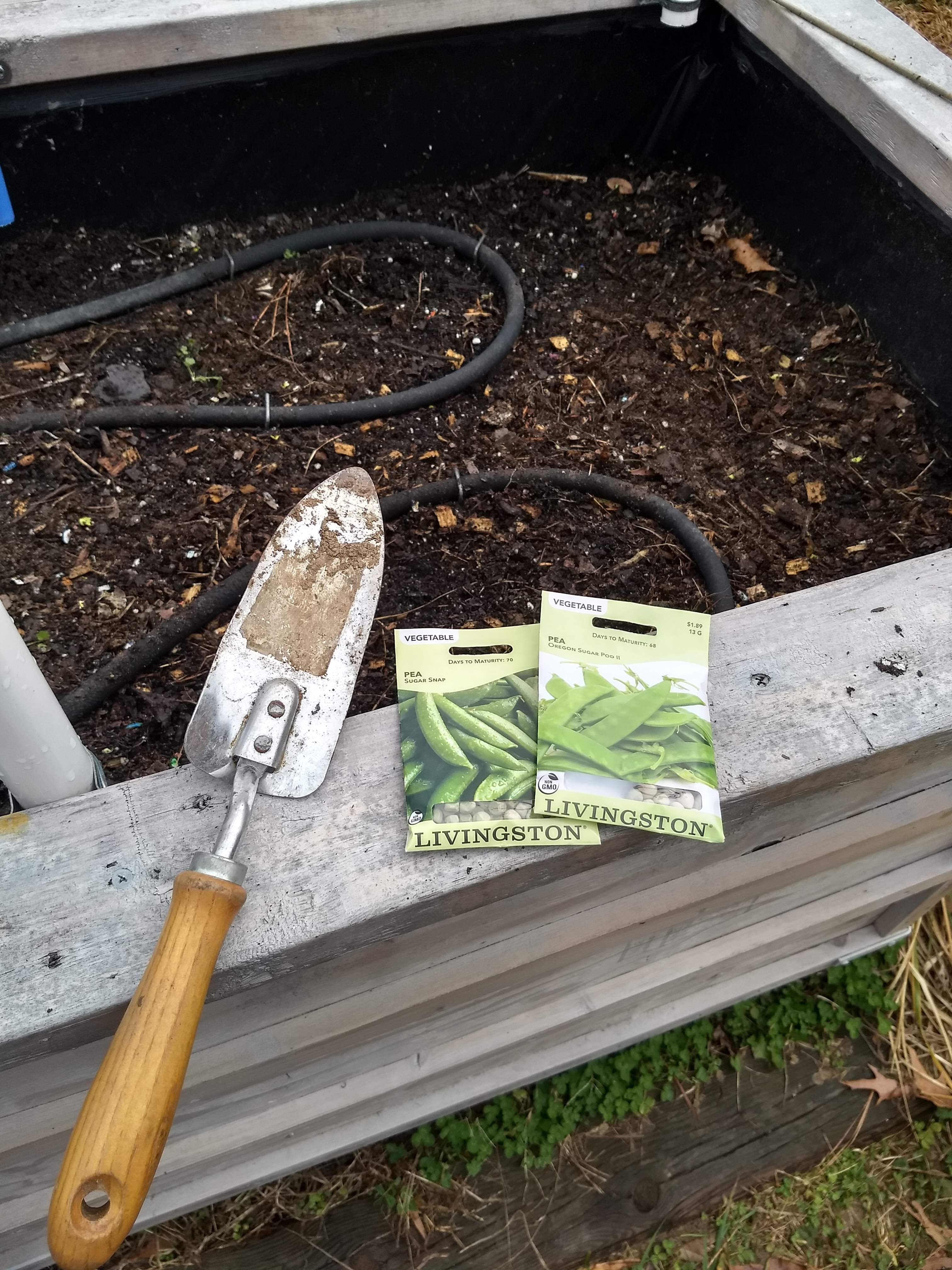
You can watch the seasons change in real time in the garden. Things root and sprout and grow and die and hibernate. Noticing the differences from week to week is a really graceful way to mark the passage of time. Much healthier than what I have been doing: curling up in a ball on my couch and whining about how the rain and gloom just won’t go away.
In the garden this morning, I cleared out some raised beds that still had remnants of greens from the fall and planted sugar snap peas. Planted! Peas! It’s the end of February, and it is time to PLANT things. Hallelujah. Peas are the early crop, of course, and we’ll harvest and pull them up and re-plant those beds several times over the season. But the act of sowing seeds in soil, anticipating the magic of watching them grow with nothing other than light and water and a little tender care is hopeful.
I also got to deadhead some of last season’s mums that were starting to show some new life – I didn’t even KNOW that mums were perennial. The local ACE hardware store donates leftover seeds from the previous season, and this batch includes a LOT of pumpkins. So we started envisioning a pumpkin patch by the back fence, ornamented with these mums – leftover from a garden store’s autumn sale.
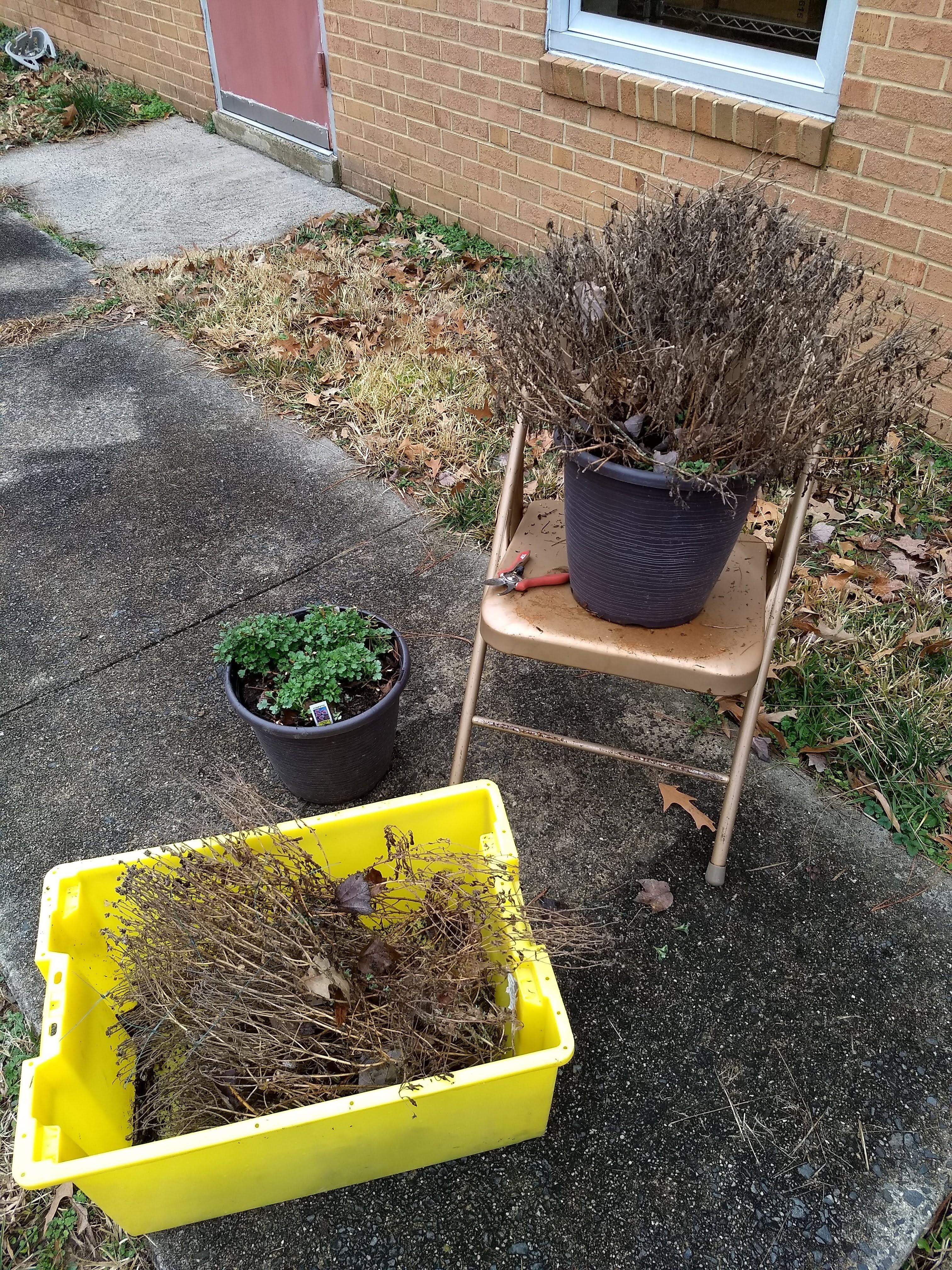
I came home and promptly tended to the skeleton of a mum hanging basket that I’d abandoned on my own porch, hoping that it, too, might have some new life left in it.
Nearly everything in the community garden is donated, re-used or recycled. The raised beds are made from shipping crates. The compost comes from the connected Food Hub’s waste. The plants get donated. The labor is all volunteer. I love it. It feels like magic – that simple things otherwise tossed into the garbage come to life and turn into FOOD that feeds me and my neighbors all year long.
Nothing profound to say here, as I write late in the day to fulfill my daily writing commitment: just deep, deep gratitude for the magic of the ParkTown Food Hub Garden and the privilege of getting to be a part of it.
I had work meetings every night this week, which is a regular occurrence these days, and pretty standard for pastoral schedules. I juggle two jobs: a congregation and a program designed for and led by multi-vocational pastors. The bulk of this work necessarily happens in hours other than 9-5, since most of my colleagues, constituents and congregants are busy with other commitments during the daytime.
In general, I prefer a flexible schedule that allows me to take a long lunch or a slow morning when I know I’ll be working from 4-8pm. Especially during this time of year, it allows me to be outside when the sun is shining, sitting down at the computer once it sets. I worked 8:30-4:30 in a flourescent-lit cubicle for a couple of years and hated it with a passion.

But sometimes, the weird schedule starts to wear on me. This year, my tiny apartment has seemed more like an office than a respite. There is no strong delineation of workspace from leisure space, no standard hour to mark “working” time from “living” time. Sure, there are all kinds of tips and tricks for working from home, and I’ve tested them all out: take a walk around the block at the beginning and end of your day to replace your commute & put boundaries around that time; make sure to put on shoes when you go to your desk to be productive; carve out specific and dedicated space for work; turn e-mail notifications off on your phone; shut the computer down for the weekend.
Some of those things are helpful, but when work doesn’t exist within clear time boundaries and EVERYTHING is happening in the same, tiny physical space, boundaries are hard.
I am generally good at boundaries. I came with them pre-installed in my personality, I think. Fridays are my sabbath day and I’m decent at protecting that time. But in weeks like this one, when I’ve been in meetings until just before bedtime and Zoom calls ate up all the reflecting and processing time, when my day off is taking place in the same chair where my workweek happened, driven inside because the clouds are back and the rain just won’t stop…it takes more than one or two days to remember how to exist as a being who is valued for who I am and not what I can produce.
This is not meant to be complaint. I love my work. I prefer flexible schedules. I understand the privilege of being able to work from home right now. It’s just an acknowledgement that everything is harder, these days, and that the delicate boundaries and balances we had been using to survive in the times before the pandemic have been, to put it mildly, completely obliterated. We are grasping for handholds and, in many cases, barely holding on.
This is just me being honest about what’s hard, in the hopes that honesty opens paths for mutuality & creativity. And now, seeing as it’s Friday, I’m going to close my laptop and go do some LIVING instead of getting caught up in even more WORKING.
My congregation is partnering with our neighbors at the UMC church down the road for Lent, and using these Again & Again resources. Last night, Pastor Anita led a devotional time of scripture & visio divina with art created for the series. (It’ll be every Wednesday evening ’til Easter, and you are welcome to join, too.).
One of the pieces of art we reflected on was called “I Delight In You,” a digital painting with collage by Lisle Gwynn Garrity:
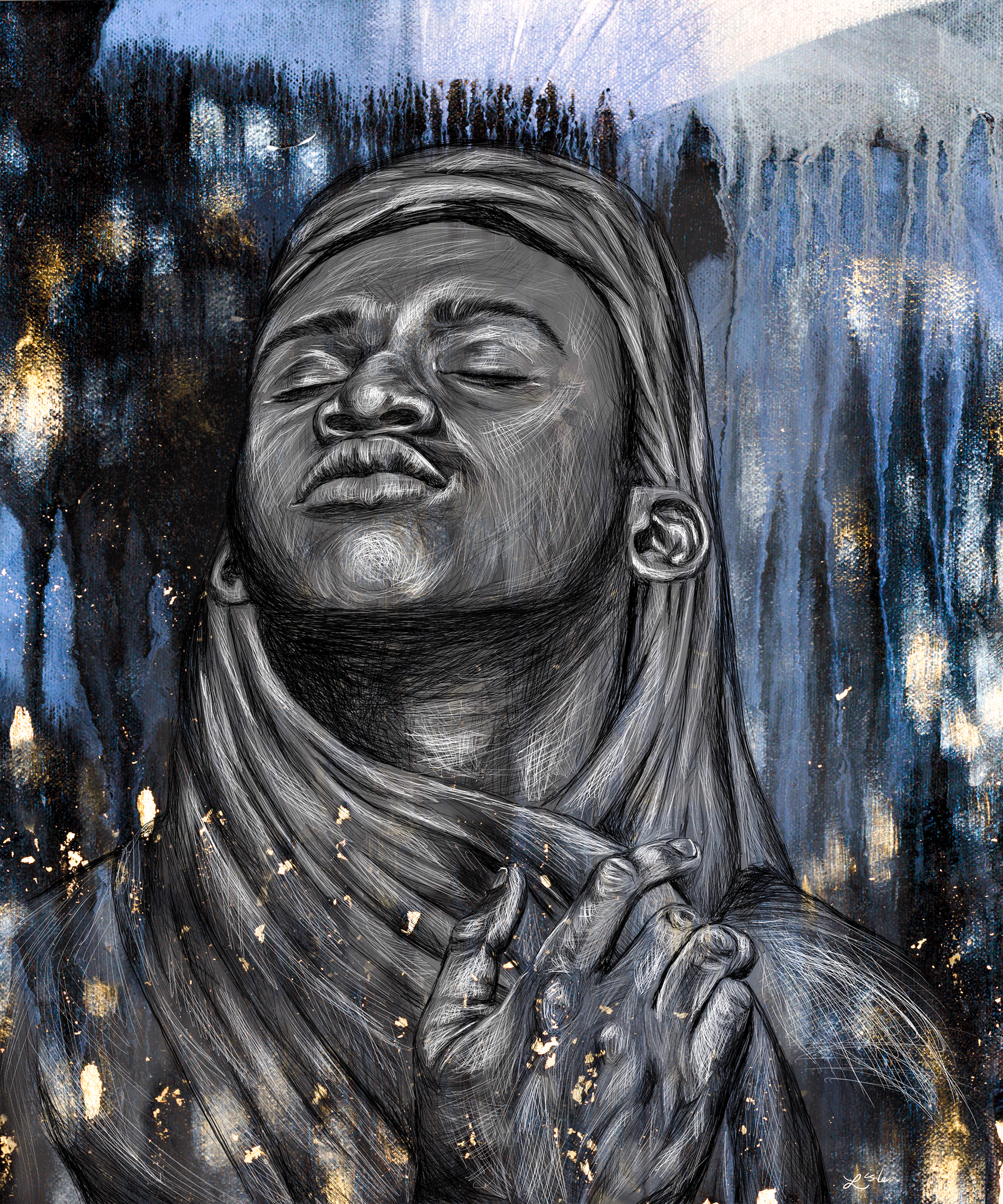
The way visio divina works, we are invited to sit with the work of art and notice where our eyes are drawn. What do you see? What do you notice? Can you imagine yourself inside this image? How does the image make you feel? When you pair the image with scripture (for us, last night, the story of Jesus’ baptism in Mark 1), what connections do you make? What does the image illuminate in the passage?
Try it out, if you want.
Yesterday, the sun shone uninhibited in a way that it hasn’t been able to all month. The temperature climbed up to 75 degrees, and the spongy ground finally dried up a bit. I decided to take my lunch out to the lake for a beach picnic, to celebrate. But when I arrived, excited about my turkey sandwich on the sand, well…

…there was no beach.
The month of rain had caused the lake – built for this very purpose of controlling the region’s flooding – to leap over its shores and swallow up picnic tables, pavilions, parking lots, volleyball courts and playgrounds. Kids trolled the new shoreline and leapt over flooded sidewalks. Franny sniffed her way through the flotsam and jetsam. I rolled out my picnic blanket on a piece of high ground and ate my lunch in the sunshine, anyway.
I tilted my head up – just like the person in the painting – and soaked in the sun, there on a dry island nearly surrounded by flood waters. The rain is returning tomorrow, for the better part of a week, and I willed my whole self to be like a sponge, collecting as much of the warmth and encouragement and promise of spring as I could for those few moments.
The pain and grief and trauma and anger will keep coming. A friend told me this week that we should prepare ourselves for the emotional kickback once we’re through the worst of this pandemic, that when we’re no longer completely invested in survival, those responses – anger, irritation, anxiety, depression – will find the space and make themselves known, and we should get ready to welcome them and give them the necessary space.
And still, even in the midst, there are moments of sun to be soaked in, moments of gratitude to be fully expressed, signs of promise to be caught and inscribed on our hearts. We get to turn our faces to the light and receive its gift, even if we’re sitting on a tiny patch of dry ground and surrounded, still, by ever-so-slowly-receding floodwaters.
Thanks be to God.
 like color