mitigating risk

Luke 1:48: for he has looked with favor on the lowliness of his servant. Surely, from now on all generations will call me blessed;

I love Mary’s song. I have this print by artist Ben Wildflower on two t-shirts and a sticker that lives on the front of my laptop.
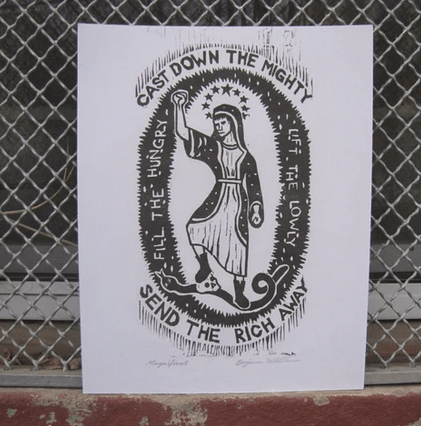
On Sunday, I preached about Mary, who is blessed, highly favored & chosen. Except, it turns out that all those superlatives applied to her *before* she agreed to bear & birth the Son of God.

Sometimes we think about Mary as blessed because of who Jesus turned out to be, illuminated by the glow of her child’s accomplishments. But Gabriel assures Mary that she is blessed, favored, accompanied by God, even before he delivers God’s request. In fact, those are the first words he says to this scared girl. Don’t fear: you are blessed. God loves you. Getting mysteriously pregnant and becoming the bearer of God into human flesh hasn’t even come up, yet, and Gabriel is reassuring Mary that she is good, beloved, valued, honored.

We might do well to think about that a little more. WHY is Mary blessed? It is not because of Jesus: according to Gabriel, she was blessed long, long before Jesus’ tiny screaming infant body ever broke onto the scene.

Even later on in Luke’s own gospel, we learn about Mary’s blessing. After she hears from the angel – after getting over her confusion and being super perplexed – Mary goes to visit her cousin, Elizabeth, who has just had her own angelic experience. And Elizabeth confirms Mary’s blessing, in this way: she says “blessed is she who believed that there would be a fulfillment of what was spoken by the Lord.”

Elizabeth doesn’t say “blessed is she who will bear God’s own son.” She says “blessed is she who believed that God’s word would come to pass.” Believing – not bearing – is the root of this blessing.

Jesus even gets in on the conversation, once he’s grown enough to have a say – and he doesn’t do it once, but twice. First, while he’s teaching a huge crowd of people, Mary and Jesus’ brothers show up and someone passes him a note: hey, your family is here! But Jesus refuses to give his flesh & blood relatives any preference over the others there in the crowd: “My mother and my brothers are those who hear the word of God and do it.”

And, again, when Jesus is teaching another crowd, someone pipes up in adoration and yells out, blessing his mother: “Blessed is the womb that bore you, and the breasts that nursed you.”

One of the things about Jesus that constantly amazes me is that even 2,000 years ago, he consistently refused what we’d call today “sexism” or “misogyny.” The woman yelling from the crowd is blessing another woman’s womb and breasts, diminishing her entire existence to a few body parts that make her able to grow a child. As if any human being is loved by God because of their mere physical appearance or ability.

Jesus is having none of it: “Nope,” he says. “Blessed rather are those who hear God’s word and obey it!”

Mary is blessed and beloved, not because she is the mother of God, but because she heard God’s call and agreed to accept the invitation.

I am convinced that each one of us is already blessed, already beloved, already highly favored, already chosen. We are not blessed because of any special ability or gift or because we get chosen for an especially holy task; we are blessed when we hear God’s word and obey it. We are blessed when we believe that God fulfills God’s promises and agree to become part of that happening.

I believe that God is speaking to us even now, through angels and dreams and friends and neighbors and headlines and social media feeds and those weird, unprompted nudges we get to do something or say a word or send a note. God is speaking. God is turning the world upside down, and we are invited to join in. “Greetings, favored ones! The Lord is with us!”

(with thanks to Mark Allen Powell’s commentary on this passage from Working Preacher.)
virtual

Luke 1:51: He has shown strength with his arm; he has scattered the proud in the thoughts of their hearts.

I saw my Mammaw this morning. She’s 90 years old and every time I see her, I ask for stories. She’s got some great ones, about my great-great grandmother, Granny Guinn, who was widowed and dealt with the economic fall out by sending her kids to live with relatives, selling her land for a horse & a shotgun, and making a living as a midwife delivering babies up and down the mountains that stretch across the Kentucky/Virginia border.

And then there’s my Mammaw’s mean Aunt Belle, who charged her own niece an inflated price for butter and when her husband lowered the rent on the house Mammaw and Pappaw were living in – lower, at least, than what she thought it should be – she decided to plant corn in the adjacent field right up to the drip-line of the roof in order to make up the losses.

Mammaw’s memory is fading, though she can still painstakingly name all her cousins in birth-order, if you’re patient enough. She doesn’t really remember the stories I like best, even when I prompt her. But I think we might have discovered a 1918 pandemic story, today.

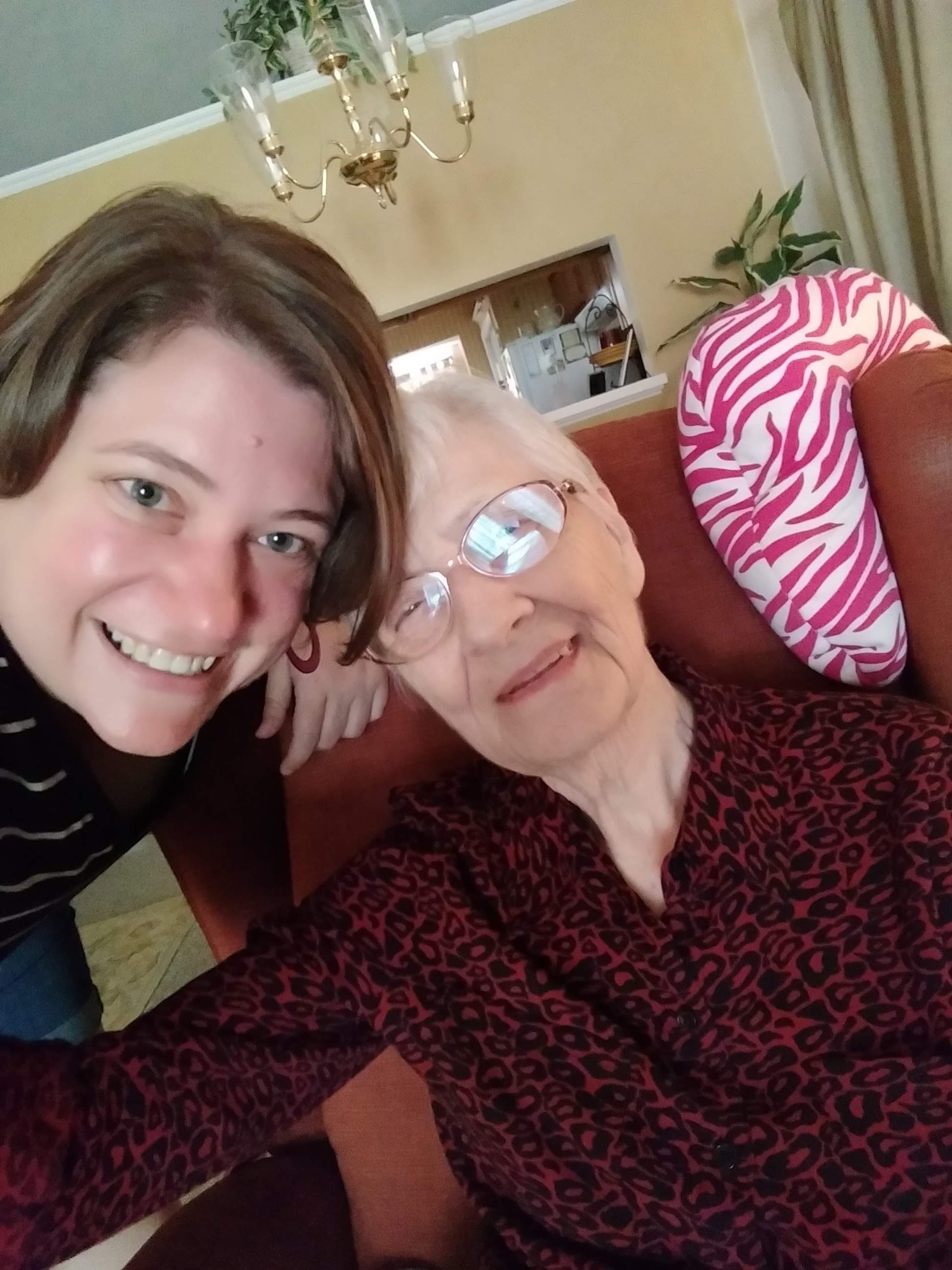
with Mammaw last summer

Mammaw’s father, Paris Stiltner, was married twice. His first wife, Sarah Sawyers, had two children before she died sometime around 1918 and Paris got re-married, to my great-grandmother, Elizabeth. Mammaw doesn’t remember what killed Sarah, but she does remember that the whole house was so sick during that time that when my great-grandfather, Paris, recovered, he couldn’t even remember getting the news that his wife and oldest child had died of whatever had nearly killed him.

Life in Eastern Kentucky in 1918 was no picnic. Mammaw paused, this morning, staring out into the distance, and said “you know, a lot of people died there in that time.” It’s hard to tell if Sarah and her daughter, Marie, died from one infection or another, but the story sure does fit the timeline and the outline of so many similar pandemic stories. I am left with the possibility that my very existence, like so many, is possible, in part, because of that unspeakable pandemic a century ago.

Paris wouldn’t have married Elizabeth and Mammaw would never have been born if Sarah hadn’t died. And if Mammaw hadn’t been born, of course, my mom wouldn’t exist, and neither would I.

The story of Christianity is the story of death and resurrection. Just like all of creation, humans are subject to the cycles of birth, death, and re-growth. Compost and humus feed the next season’s crop. Letting things go makes space for new life. It is not always the life we want or the life we would choose, but we humans are part of the cycle, nonetheless. In the empty spaces, God nurtures newness.

I have seen this happen when a parent’s grief makes room for incredible compassion, when a lost job opens up unspeakable opportunities, when a destroyed building frees a congregation to embrace more immediate ministries. I have seen the end of relationships lead to deep flourishing of individuals. I have – this year – seen smelly, rotten food waste be transformed by time and warmth into compost that fed the garden collard greens I ate last week.

Can we allow that kind of transformation to take us over? Reframe our losses – after mourning them – to be what they are: open space for something new? What will grow, here in the nutrient-rich ground that’s been tilled up with loss and watered with grief?

It’s easy for me to think this way when the timeline is generational – I never knew Sarah or Marie and even Paris and their second daughter, Stella, exist only as characters in my Mammaw’s stories to me. I know it is harder to see grief and loss as a clearing of space, a making room for something new when the losses are fresh and raw and barely even old enough for us to name. I know.

But God’s timeline is so much less immediate than our tiny human ones. It’s even bigger than generations; it is COSMIC. And when Mary sings her song – that she learned from her own great-great-great-great grandmother, Hannah – she insists that this God is the one who puts things to rights, nurtures newness, orchestrates justice, comforts the mourning, lifts up the lowly, fills the hungry with good things and remembers his promises that he made to the ancestors…FOREVER.

So. I don’t know to what all I owe my own small existence. The 1918 flu pandemic certainly might be one contributing factor to my direct ancestral line. But I do believe that loss makes room for possibility, even if it takes years – or generations – for our tiny human hearts to see it happening.

What will grow in our grieving hearts? What new life is God tending, even here, even now?

muted

1 Samuel 1:13: Hannah was praying silently; only her lips moved, but her voice was not heard; therefore Eli thought she was drunk.

Last night, I joined a Blue Christmas service. Have you heard of these? It’s a particular kind of worship service designed to make space for the grief and pain so many of us feel over the holidays. This year, in particular, we are all carrying so much of it.

Three clergy women colleagues guided us through the service, lighting candles and giving us permission to feel what we need to feel – even if all the rest of the worlds’ messages right now are telling us that JOLLY is the appropriate emotion, even here, even now.

In Advent, Christians traditionally light four candles – one for each week of the season. The candles represent the gifts of the waiting season: hope, peace, joy and love. In last night’s service, Pastor Mandy, Pastor Audrey and Pastor Angela lit candles honoring grief, anger, sadness and loneliness, those parallel states inextricably entwined with the season’s gifts.

My own grief and sadness are pretty close to the surface these days. Every day, I learn of another tragedy. The compounded grief of so many losses is real, and I can feel it in my easy tears and quick annoyance. I knew the opportunity to allow myself to be led into worship, instead of leading others – again – would be important. I knew that I trusted these pastors, in particular, to create sacred space for hard feelings. I was grateful for the invitation.

I did not expect to be punched in the gut, however, with gentle acknowledgement of anger and loneliness as holy things. I am still – even weeks into this practice of daily reflection – full up with anger. Angry at Congress for the $600 slap in the face “relief” bill they passed this weekend, angry at strangers choosing super risky holiday celebrations, angry at other strangers shaming me for my choices, angry at billionaires hoarding wealth when my neighbors are going hungry, angry at colleagues who have no creative energy left, angry at a healthcare infrastructure that allows hospitals to fill and denies care to the poor, angry at landlords poised to evict people next week, angry at the USPS for losing my packages, angry at Postmaster General Louis DeJoy for dismantling the USPS in the middle of a pandemic, angry at politicians who actively spread the virus getting their vaccine first, angry at the church for failing, failing, failing in our call to join in God’s healing justice, angry at SO MANY mediocre white men who are even now just luxuriating in their privilege to be loud and wrong, angry at the existence of the Trump Store on 220 in Boones Mill, angry at myself for not doing or saying or shouting or resisting more of all this evil. I am SO FUCKING ANGRY.

And last night, Pastor Audrey lit a candle in honor of that anger. A candle. A point of light. A reminder that anger is real and right and human; a reminder that anger is holy. Worthy of attention, worthy of being voiced and expressed and acknowledged.

And that’s when I started crying.

In today’s scripture, Hannah is losing it in the temple. She is weeping and praying and making deals with God. She has refused to keep her feelings to herself. She’s doing it all silently, though, which makes her look INSANE, and Eli, the priest, is certain that this drunk lady is profaning the sacred space.

He tells her to get out, but she refuses. “NO,” she says. “I’m not drunk. I’m pouring out my soul.” Eli, who I imagine must have been pretty skeptical, says “well, okay, go in peace, then.” But God heard Hannah – every word of her holy grief and anger – and granted her prayer. When she realizes that God has heard her and remembered her and answered her sobs and screams, she sings a song. And that song became famous – not only in her own family, but in ours, too. When Mary, Jesus’ mom, gets a visit from an angel and learns that she’s going to give birth to the Son of God, she reaches way back into the stories from her great-great-grandmothers and improvises on this song from Hannah.

Anger is holy. Grief is holy. Loneliness, longing and pain are HOLY. And we are not built to keep all of those powerful, moving, transformative feelings muted. We are invited to wail and weep and scream and shout – to do it, even, in God’s own sanctuaries. Because the world needs those songs, too.

sheltering in place

2 Samuel 7:2: the king said to the prophet Nathan, “See now, I am living in a house of cedar, but the ark of God stays in a tent.”

I’m at my parents’ house in Virginia, sheltering in a new place for the next couple of weeks. (Requisite caveat: I tested negative for COVID-19 on Wednesday after isolating for two weeks. Isolation, for me, meant not being inside any building other than my home for longer than the 2 minutes it takes for me to grab my take-out order off the counter at Bean Traders.)

I have been very, very grateful to live where I live this year. My tiny apartment is tiny, but it is mine. My neighborhood has miles and miles of walking trails, allowing me to step out the door and get my 10,000 steps in easily. There are TWO local, quality coffee shops within a mile’s radius, and dozens of local restaurants, as well. My church is right down the road, and while we haven’t been meeting in person, our partners at the nearby UMC host the Food Hub where I get to volunteer in the garden and find safe, outdoor human interaction.

Durham is also *committed* to mutuality and caring for one another. Everyone wears masks. Local government and businesses have gotten super creative to keep people connected and fed and paid. I’ve been in meetings with clergy and health department leaders working tirelessly to keep lines of communication open and information sharing clear and robust.

And I live 3 hours from my parents and a little less from my sister and her family. That has meant that I’ve been able to see them all – at my nephew’s baseball tournaments, in my sister’s driveway, kayaking in Durham on my birthday – several times this year. I’m grateful to have a job and a life that is anchored just a few hours from my family.

I love where I live. I’ve lived in Durham 5 years now, the longest I’ve been in any place since I graduated from high school.

And. Even though geographic and economic disparities mean that, right now, some places are healthier and safer than others (church folks made sure I knew that Durham just got named Best City to Celebrate Christmas), today’s scripture reminds me that God isn’t any more or less present – no matter where we happen to be.

King David wanted to build God a house, to save God from living in a portable tent. But God wasn’t interested. The text after the highlighted verse, God says:

I have not lived in a house since the day I brought up the people of Israel from Egypt to this day, but I have been moving about in a tent and a tabernacle. Wherever I have moved about among all the people of Israel, did I ever speak a word with any of the tribal leaders of Israel, whom I commanded to shepherd my people Israel, saying, “Why have you not built me a house of cedar?” Now therefore thus you shall say to my servant David: Thus says the Lord of hosts: I took you from the pasture, from following the sheep to be prince over my people Israel; and I have been with you wherever you went

I have been with you wherever you went.

Later on, Solomon does, in fact, build a temple for God. And you know what happens? Generations later, conquering armies blow through and destroy it, and send God’s people scattered into exile. And it sucks. The losses are unimaginable. The people cry out: “how can we sing God’s songs in a foreign land?!” But God doesn’t disappear. God sticks with God’s people – when they are at home, when they are in exile, whether they worship in a tent or a temple.

I’m filled with gratitude for this place where I have landed. And I know, too, that had I been sheltering in place in any of the other cities where I’ve made a home – in Richmond or Manassas or Salem or Oxford or Elgin or Atlanta or Williamsburg – there would be gifts and graces and newly discovered corners and wonders. I am certain that wherever you are – in your tiny city apartment or your isolated mountain home – God is with you. God has been with you, wherever you have been.

unprecedented

John 7:40: When they heard these words, some in the crowd said, “This is really the prophet.”

I hate this word. I think it is hardly ever accurate. Everything has a precedent – even the emergence of COVID-19 can be traced and compared to previous pandemics and chains of causation. There are an “unprecedented” number of active COVID cases in my county this morning – 1,095 – but we KNEW this would happen. We knew how to prevent it. The number is higher than its ever been, but it’s not like we are at a loss to understand how it happened. There is precedent: when entire populations fail to take proven preventative measures, pandemics rage on. The government refuses to pay people to stay home, bad actors persist in spreading misinformation, and our care for one another is smaller than our selfishness.

Even when it feels like we have no framework for understanding, even when it seems like there is no data to help us through, even when we feel completely at a loss…we’re usually wrong. There is wisdom and creativity and conviction and divine guidance available to us. In every moment.

When Jesus was traveling around the ancient world teaching and preaching and healing people, nobody really knew who he was or what he was up to. There were raging debates among religious scholars and leaders about whether or not he was a grifter, a prophet, a poser or the actual Messiah. According to the gospel writers, Jesus himself was confusingly hot and cold about whether or not he WANTED people to know – or, at least, whether or not he wanted CERTAIN people to know.

Jesus – the Christ – God Incarnate – was certainly unprecedented. Except also, not. John’s gospel starts right out by saying that the Word that became flesh was with God in the very beginning, and everything that came into being did so through him. So, of course, Christ’s birth was unprecedented. And also, Christ’s birth had the most precedented precedent of all.

This simultaneously frustrates and encourages me: I am held by the knowledge that there is no human situation we can get ourselves into that will shake God. And we have access to that divine care and guidance in every moment. And also, we humans persist in running around like chickens with our heads cut off, trying to rely on our own understanding and grit instead of pausing, slowing, listening and proceeding with CARE.

I hope that these last weeks of 2020 offer us all slower moments, and that we willingly enter into them, with open hearts and minds. I hope we can set aside the frantic anxiety of this time and sit, quietly, to be connected again to our roots, our ancestors, and the God that I imagine laughs a deep belly laugh every time the word “unprecedented” shows up on our lips.

now more than ever

Psalm 89:2: I declare that your steadfast love is established forever;
    your faithfulness is as firm as the heavens.

A couple of weeks ago, I was standing the cold eating a homemade cinnamon bun and talking about the flu with church people. We’re trying to gather outdoors in masks once each month to convince ourselves that even though we mostly encounter one another on computer screens, these days, we do still exist in the flesh.

We were searching our memories for stories passed down about the 1918 flu pandemic. One third of the world’s population contracted the 1918 H1N1 virus, and it killed nearly 700,000 Americans. With those kinds of numbers, we knew that our families couldn’t have been exempt from the universal grief and pain. But we also couldn’t recall any stories from that era. None of us gathered could recall our parents or grandparents or great-grandparents ever talking about it.

“Maybe the war just overshadowed it,” someone suggested. “Maybe people were just more experienced with death,” I said. “Oh, every family in town has lost someone this winter? Guess it’s the flu that’s killing people this year instead of tuberculosis.”

I read an article about how after that pandemic a century ago, people intentionally avoided the subject. It is actually known, today, as “the forgotten pandemic”:

“Never since the Black Death has such a plague swept over the face of the world … [and] never, perhaps, has a plague been more stoically accepted,” commented The Times in December 1918, at the height of the deadly second wave of the pandemic.

https://theconversation.com/why-historians-ignored-the-spanish-flu-101950

There are plenty of theories among historians about why there are so few records of trauma, no memorials to the dead, no pandemic wisdom passed down through generations. There was a war, after all, and the pandemic dashed real hopes of scientific progress. And also, man, who wants to hash out the worst period of their life over and over again?

We have some resources, now, to know more intimately what happened in those days a century ago that are so frighteningly like these days, now.

One of those resources are the living, breathing elders. The oldest couple in my congregation joins us every Tuesday evening for online fellowship time, and it is the most reliably jolly hour of my week. We swap recipes, tell inappropriate jokes, and listen to stories. I asked them, the week after that cinnamon bun conversation, whether they had any memory of family stories from the last pandemic.

And, oh, do they. It turns out that our beloved, wickedly funny Ruby has graced this world for almost 90 years in part *because* of the 1918 pandemic. Her father’s first wife caught the flu and died, leaving him alone with four children – one an infant just a few months old. The community sent in a young woman to cook and clean and help him get through and, wouldn’t you know it: they fell in love. They married and had several more children, Ruby included.

I don’t think her parents talked much about the details of the flu and its horrors, but she still managed to convey, in her telling, a bit of the darkness of that time. The weight of grief was part of her growing up, I think. It must have been.

And yet, here she is, this vibrant jokester who loves a good midwestern snowstorm, Christian mystery novels and the movie Home Alone, probably solely responsible for most of my genuine belly laughs this year. Out of so much grief and pain came Ruby, a straight-up GEM.

We don’t really take much time to listen to peoples’ stories these days, and I really wish we would. There is wisdom and revelation, there. We are not the first humans to trudge through this kind of unimaginable grief and pain and loss, we’re just achingly unprepared for it. People have endured so much – so much more, even, than this – and their stories are a gift to receive.

One of the theories about why we don’t know much from the 1918 pandemic is that entire populations were traumatized, and talking about the horror simply hurt too much. Maybe that’s a lesson for us, today: if we all agree to be honest, to name our loss and grief and pain, to insist that our leaders acknowledge it, too, to refuse to participate in cruel pleasantries and double down on answering questions like “how are you?” truthfully…maybe we can offer a gift of wisdom for generations to come. This hurts. It is unimaginably wrong and painful and we are not sure how we’ll survive it. In fact, we know that every 30 seconds, some beloved neighbor fails to survive.

It is important to face the truth. It’s important to understand that this is changing the face of human experience. If we are honest about it, then we might stand a chance of changing things for the better. What’s that line from James Baldwin?

“Not everything that is faced can be changed, but nothing can be changed until it is faced.”

God was present with every sick and dying person in 1918, with every grief-stricken spouse and child, with every family and community struggling to fill the gaps and keep one another alive. And that same God, whose faithfulness extends from generation to generation, whose steadfast love is established FOREVER, is with us now, too, in every ICU room, with every nurse and teacher and delivery driver and funeral home attendant, with every grieving partner and child kept apart from their dying loved one. We are not alone, and this is not the first time God has endured such grief alongside us.

one day at a time

Psalm 89:1: I will sing of your steadfast love, O Lord, forever;
    with my mouth I will proclaim your faithfulness to all generations.

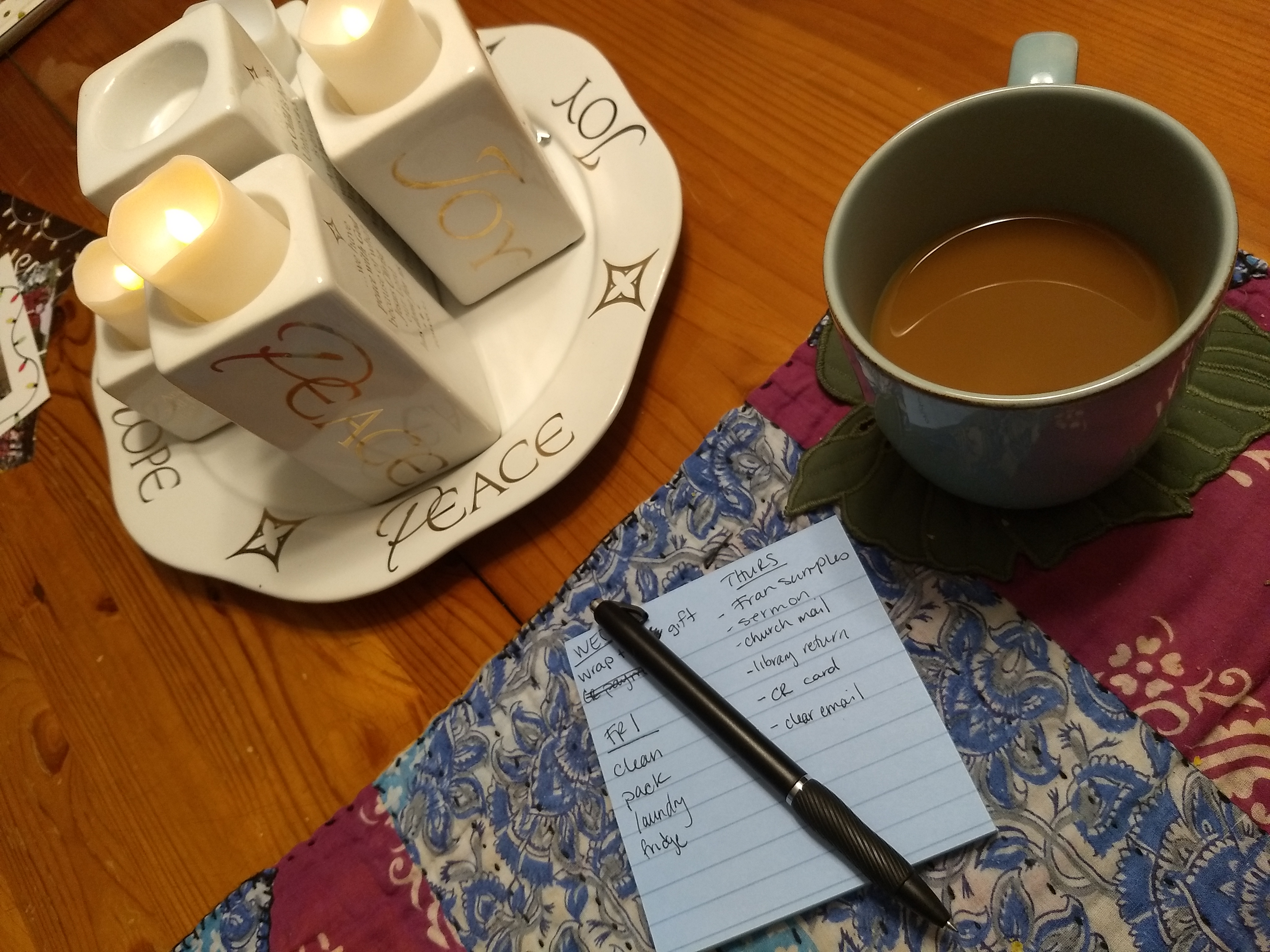
I’m not great at living one day at a time. I like projections and systems thinking. Right this minute, in fact, there is a post-it note with the rest of this week’s tasks planned out sitting here next to my coffee cup.

(The first entry for today is to collect and deliver to the vet forensic samples from the dog’s excrement. We’ve already managed the collection part of that endeavor, which makes this day a total success before 8am in my book.)

Especially over the last few months, list-making and future planning have kept me sane. I’ve gotten deep into meal planning and created a weekly spreadsheet so I know what I’ll be eating each day. I hung a whiteboard by my desk, where at the end of each workday I write the 3 top tasks for the next. I visited 14 North Carolina State Parks this year, and entering each one on the spreadsheet, watching the blank spaces slowly fill up was deeply, deeply satisfying. Opening a single window on Fran’s daily Dog Advent Calendar is basically the highlight of our day.

When the world explodes and so much is uncertain, sticking to a plan is comforting. Even if something *else* explodes in my face spectacularly, at least I know what’s for dinner. At least my day off hike is planned and ready. At least I can exert these tiny measures of control over life.

It’s all an illusion, of course. No matter how much planning or list-making or spreadsheet filling I do, people are still dying at a rate of more than 1 per minute. We are still mired in the original white supremacy that created America. Cruelty is still coming out on top.

I realize, though, that maybe working the to-do list actually IS living one day at a time. One meal, one hike, one email, one Advent treat and the day is done. On to the next one. One foot in front of the other, trudging through these brutal days.

Even these daily blog posts – three weeks’ worth, now – are handholds to get me through. You know who understands this kind of thinking? Addicts who are working 12-step programs. One day at a time is not a feel-good cliche; it is a life-saving practice. One day of sobriety, then the next, and another, and another until an entirely different way of inhabiting the feels not only possible but already part of your routine.

Advent calendars end at Christmas. The waiting is over. The daily plodding toward celebration ends at Christ’s birth. But January and February are still cold, dark months. Epiphany only gets us so far. What will we do, one day at a time, to heave ourselves through them?

I know my meal planning and whiteboard writing and hiking challenge will go on. And maybe I’ll keep the Christmas lights and Advent candles lit through the winter, a reminder that we’re all still holding on to the hope of salvation even after Jesus’ birth.

flatten the curve

Malachi 4:1-2: See, the day is coming, burning like an oven, when all the arrogant and all evildoers will be stubble; the day that comes shall burn them up, says the Lord of hosts, so that it will leave them neither root nor branch. But for you who revere my name the sun of righteousness shall rise, with healing in its wings. You shall go out leaping like calves from the stall.

Flattening the curve is something that the US just can’t manage to do. A lot of the world had resurgences of COVID this fall, but the US seems singular in our inability to control the spread. According to my morning news briefing, Belgium, France, Italy, Kenya and Saudi Arabia saw their case numbers fall over 50% in the last month. Numbers dropped more than 40 percent in Argentina and Morocco and more than 30 percent in India and Norway. Meanwhile, here in the United States, cases have RISEN 51% over the last month. We are doing the opposite of flattening the curve.

The NYT/sources: local health agencies + The World Bank

O Lord, make haste to help us.

This is the work of evildoers, and that category certainly doesn’t end with the current President. The evil here in our country is anchored in arrogance – that we are isolated and independent and anyone who can’t pull themselves up by their bootstraps is malformed and unworthy. This insistence that we do not belong to one another, that your health does not affect mine, that my responsibility ends at the property line and my so-called “rights” are more important than your life: this is not just short-sighted or evolutionarily foolish; this is evil.

Certainly the people in positions of power who have refused to craft and endorse policies that center care for all are doing evil. Certainly the lawmakers and lobbyists and economically powerful who decide to do what is most advantageous for themselves and their donors instead of what shores up the well-being of ALL of us are doing evil. And: when we live our own small lives as if what we do doesn’t affect anyone else, as if it is only our own, private salvation that matters, then WE ARE DOING EVIL.

Putting your kids in private school in order to avoid being a part of the failing neighborhood public school: evil. Hoarding wealth while neighbors go hungry: evil. Ignoring the way COVID is raging through prisons in order to ensure your own place in the vaccine line: evil. Continuing in-person worship in order to satisfy your biggest donors while ignoring the fact that you are endangering the elderly and vulnerable in your care: evil. Hosting big holiday parties in your house while your local funeral home employees are flat-out exhausted from all the COVID deaths in town: evil. Refusing to wear a mask in public while COVID-19 is killing more than 1 beloved child of God EVERY MINUTE: EVIL.

People do evil – it’s part of being human. Much of Christian theology centers around the possibility of confession, repentance and repair of the evil and harm that we do in the course of living. We cannot escape being wrong or doing evil in general but SO MUCH of this current evildoing is entirely voluntary and avoidable.

The people I know who are doing this kind of evil aren’t really interested in listening to me, but perhaps their professed faith might convince them to listen to God. Facebook friends got super mad when I said that having in-person worship is killing people, but God’s assessment and judgement of all this is FAR FAR FAR FAR worse than anything I could ever say:

See, the day is coming, burning like an oven, when all the arrogant and all evildoers will be stubble; the day that comes shall burn them up, says the Lord of hosts, so that it will leave them neither root nor branch. But for you who revere my name the sun of righteousness shall rise, with healing in its wings. You shall go out leaping like calves from the stall. And you shall tread down the wicked, for they will be ashes under the soles of your feet, on the day when I act, says the Lord of hosts.

Evildoers get BURNT TO THE GROUND. The wicked become ashes under the soles of our feet. These are three measly verses from one single prophet. If you do a survey of what God promises to do to evildoers you will end up with nightmares for months.

Evildoers – in biblical understanding – are not people who commit sins against purity. The people that God promises to BURN TO THE GROUND are not people who cuss or drink or teach Critical Race Theory or work for full inclusion of LGBTQ siblings. Evildoers are the ones who ignore, neglect, oppress and murder their neighbors with their arrogant selfishness.

So many people I know, particularly middle-class white people in the US, see the current crisis as something we can ride out and put an end-date on. The vaccine is HUGE and will do so much to mitigate the evil we are doing to one another. But God does not forget what we do in the meantime. God is merciful, gracious, and slow to anger, to be sure, but God suffers no fools. These are the days when our faithfulness, character, mercy and obedience are being judged. God does not take kindly to stiff-necked, hard-hearted people who close their ears to both human and divine pleas for compassion. In fact, God promises to BURN THEM TO THE GROUND and then snuff out the ashes with her boot heel.

I mean, it’s up to you: wanna burn in your selfishness or take advantage of God’s persistent invitation to act like you’ve got some sense?

zoom fatigue

2 Kings 2: 17: But when they urged him until he was ashamed, he said, “Send them.” So they sent fifty men who searched for three days but did not find him.

I can’t hear the story of Elijah and Elisha without thinking about this reflection that Melissa Wiginton wrote – ten years ago – about my mentor, Mary Jo Flory Steury.

Mary Jo’s calling is not only to interpret. It is a certain kind of leadership that requires holding on and letting go, leading and following, being provocative and also humble, open and receptive. What do we call the people who are being with younger pastors? With a proper name, the church could bless them in its prayers — and could call us together so we could help each other with the practice of hanging in there. We might find a clue about who these being with people are in the story of Elijah and Elisha. Take a look at 2 Kings or listen to Walter Brueggemann talk about the story. Elijah laid his mantle on Elisha as a transfer of authority, with all of its gifts and burdens, and then he stayed with Elisha for TEN YEARS. The two of them did all kinds of amazing things for God during that decade of transitional leadership. They stayed in a power-sharing relationship with each other for the sake of the community, toward a future that they both knew Elijah would not see.

– Melissa Wiginton, Faith & Leadership, February 2010

Mary Jo died in 2016. I met her in 2003, so I guess – technically – I got the ten years with her that Elisha got with Elijah, though I still feel cheated. We did do amazing things together. Mary Jo liked being in charge but she also knew how to collaborate and share power. She understood – in a bone-deep way – that what she was working for was a future that she would not get to enjoy. She told me that she knew her work for the church wasn’t the fulfillment of all her hopes and dreams for what it could be – much less all the dreams that God had for us – but that she understood her call to be about building bridges for us so that we could get from the present reality to whatever God was preparing for us, next.

On my most pessimistic days, I wonder if we have managed to stomp out all that transitional potential that Mary Jo and many others so carefully planned and proclaimed. I see our stumbles and messes and the ways we have demolished so much of what is promising and life-giving among us, the ways that the church stubbornly persists in harming the people we are called most forcefully to care for, the ways that we are so adamantly and hatefully refusing to repent and be transformed of our hard-heartedness. I work in church circles, which means I see this hatefulness literally every. day. And every day, it breaks my heart.

And every day, I see the glimmers of hope that convince me to persist. My tiny congregation exceeds every expectation. In the last two weeks, we out-pledged our budget in the first ever stewardship campaign, filled every leadership role for 2021 in a single, voluntary survey and TRIPLED our goal for supporting the neighborhood food hub’s Christmas distribution. And numbers don’t even begin to capture the commitment to prayer, ongoing conviction toward justice, investment, connection and attitude.

Last week, I got to be part of a meeting of Spanish-speaking pastors across the denomination. I took Spanish in high school and college, so I can kind of follow the gist of a conversation but I’m pretty useless when it comes to speaking, myself. So I was focusing intently on understanding, word by word and sentence by sentence when I realized that my fantastic colleague, Aida, was in the middle of a smooth and elegant explanation of a particularly prickly part of polity that Mary Jo and I wrote together eight years ago…in Spanish.

We spent YEARS interpreting this particular point of polity. I’m not exaggerating. The number of tense meetings, skeptical responses, angry retorts and outraged emails we had about this single shift were surely in the hundreds. Committee meetings, district conferences, focus groups, board meetings, Standing Committee discernment, Annual Conference debates…and all of that was AFTER Mary Jo and I sat for hours, over months, hashing out the idea and the language to make it clear. Even after she died, I was still explaining and interpreting this specificity of circles of ordination.

So when Aida encapsulated the entire idea and its implications in a SINGLE, crystal clear sentence in such simple Spanish that even I, a non-native stumbler-alonger, could easily understand; when everyone in the Zoom room simply nodded their understanding and moved right on to her next point, I sat back, astonished.

Church polity doesn’t change the world. It doesn’t feed the hungry or free the prisoners. But it does have an impact. I know Mary Jo was smiling in that moment, just like I was. It is helpful, in these brutal days, to understand all that we do as preparation for what is to come – clearing out the attics of our hearts and the basements of our organizations so that there is space and room and capacity for what God is about to do.

Because while we can draw closer to God and welcome the invitation to position ourselves in the posture of receiving unending grace and witnessing world-upending justice and becoming vehicles for those divine actions, we’re still human. We don’t know what the future holds. But we know who holds the future. Thanks be to God.

doomscroll

1 Kings 18:17-18: When Ahab saw Elijah, Ahab said to him, “Is it you, you troubler of Israel?” 18 He answered, “I have not troubled Israel; but you have, and your father’s house, because you have forsaken the commandments of the Lord and followed the Baals.

One of the delights of working for the church is working with young people. Some of y’all think I still AM young people, but I’ve got twenty years and a decade and a half’s professional experience on the college students that join Ministry Summer Service every year.

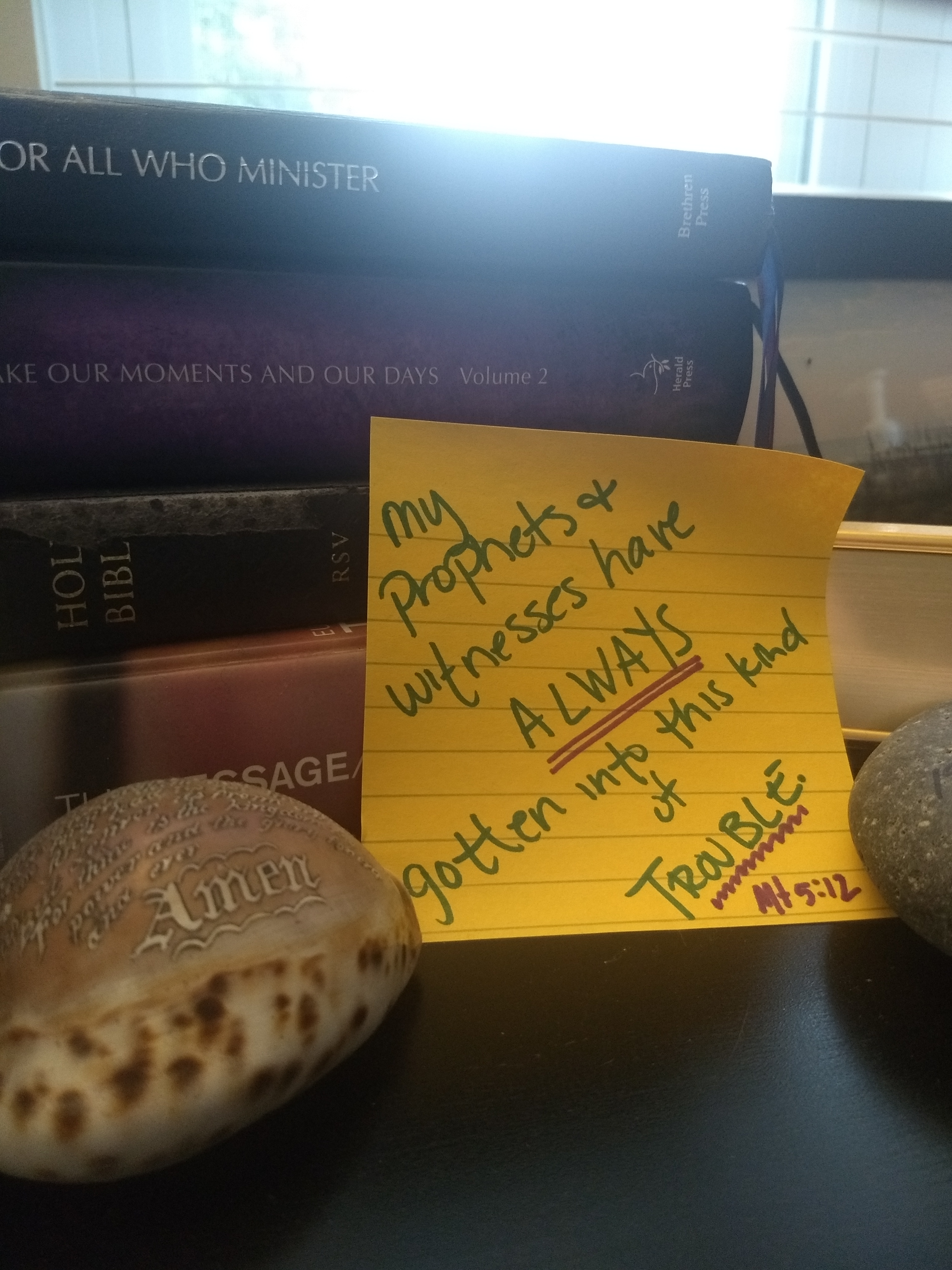
This past summer, those intrepid interns pivoted with us to an online version of what is usually practical immersion into ministry. (Read some of their reflections on the experience here.) We met every week, and every week an intern shared a devotion. The very first devotion included a reflection on Matthew 5, and this line that struck me so powerfully that I wrote it on a post-it and stuck it on my desk, where it has remained for the last six months.

I do not consider myself to be especially “prophetic.” My experience of people who claim that adjective for themselves includes a heaping helping of hubris. I mostly try to tell the truth. I love that this note includes “witnesses” in with the “prophets.” Witnesses share what they see. They describe and proclaim, articulate and name. Witnesses tell the truth.

And truth is not always convenient or welcome. I love this exchange between the prophet Elijah and King Ahab. The King sees this guy show up – again – and says “is that you, you trouble-maker?!”

This is how it always goes, isn’t it? The ones who point out the inconvenient truths are labelled “trouble-makers.” It doesn’t matter how humble, steady, faithful or committed to the group’s flourishing the truth-tellers are; if they are telling truth that unsettles, provokes, demands change then they get filed away as “instigators.”

“Oh, there she goes again, making another mess I’ll have to clean up.” I know this is how some of my telling the truth has been received, because people have SAID it, both to and about me.

I know I’m not alone. God’s prophets and witnesses have ALWAYS gotten into this kind of trouble.

But I am committing Elijah’s response to memory: I’m not the trouble-maker here, bro; you are. You are the one ignoring reality, disregarding God’s commands, submitting to the idolatry of “don’t rock the boat.”