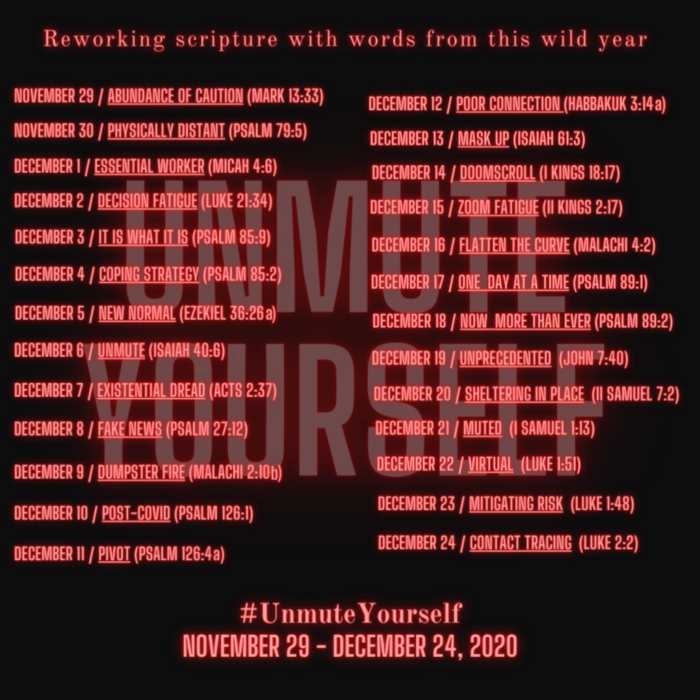
it is what it is

Psalm 85:9 Surely his salvation is at hand for those who fear him, that his glory may dwell in our land.

Surely salvation is at hand. Surely, a new day is coming. Surely, righteousness and peace will kiss each other. SURELY, the psalmist keeps saying.

We use English in ways that the psalmists did not use Hebrew. When we say “surely,” the word implies some doubt, or even a dash of the incredulous: SURELY you didn’t just insult me like that, did you? Surely you’re not going to go out without your mask! Surely, surely, surely.

We use the word “hope” in this way, too. “Will you get to go home for Christmas?” “Oh, I hope so, but it all depends, you know.” When we use the colloquial form of “hope,” what we really mean is “I don’t know.” It might happen, or it might not…it is what it is. We insert so much uncertainty into our declarations.

This is not how the psalmist talks. When the psalmist writes “surely,” they mean SURELY. This is not an expression of disbelief or outrage, it is a confession of sure and certain hope, confidence in the salvation that is already on the way. There might be little evidence of salvation on the ground, but God has promised it and that is the only evidence the psalmists need.

I would like to be like the psalmist, to snip out all the uncertainty from my language, from the world. There’s so much of it. How many people will die from COVID this month? We don’t know. Who will be infected next? We don’t know. Will we have hospital capacity to care for everyone that needs it? We don’t know. Will someone I love get sick? Maybe. Probably. Likely.

What will things look like once the vaccine arrives? We don’t know. How long will it take for the vaccine to take root? Unsure. Will enough people consent to vaccination to render it effective? We don’t know. When will I be able to eat inside a restaurant? Reply hazy, try again. Will we get to have Love Feast in 2021? Ask again later. How likely is it that we’ll see people who live across the country anytime soon? Uncertain.

Being a human in 2020 means being stuck in uncertainty. We think this is novel, like the virus that has forced so much of the mystery upon us, but it isn’t. The Psalmist who wrote those sure-fired songs of hope didn’t even know that viruses existed, how germs traveled, what a ventilator was, or how to calculate oxygen levels. Humans have always lived with unknowing; we’re just worse at it now than we used to be.

We know so much, now, connected to statistics and international headlines and combinations of explored genomes and cosmos that we walk around with a certain, low-lying hum of hubris about us. We are HUMANS. We know how to LEARN. We can ask QUESTIONS and DISCOVER answers! We are problem solvers in possession of gigantic brains. Who needs mystery when we’ve got data?

And, despite our exponential learning curves over the last couple of centuries and our newfound trust in math, we are still hunks of flesh subject to the mysteries of the created and evolving world around us. We do not know it all. We cannot solve every problem. We are contingent beings, not in charge of our own destinies no matter how many books we publish or disciplines we master.

“It is what it is,” we say, because we cannot imagine trusting the Creator to deliver us into anything better. This – the current reality – IS. Yes. But we should stop wringing our hands as if it were the only reality possible, as if the only way we know how to exist is in submission to evil. This SUCKS. It is brutal. We are broken, and grieving and floundering because we have been thrust into the deep, unsolvable mysteries of the holy.

The faithful response to grief and pain is not “whatever.” It is not “it is what it is.” A faithful response to grief, pain, loss and confusion is O GOD WHY HAVE YOU FORSAKEN US? And then, after our lament and confession, we say with the Psalmist: “surely, salvation is at hand.”

decision fatigue

Luke 21:34: “Be on guard so that your hearts are not weighed down with dissipation and drunkenness and the worries of this life, and that day does not catch you unexpectedly, like a trap.”

The third principle of Kingian Nonviolence is to “attack forces of evil, not people doing evil.” I think its a tactic for loving enemies. People are not evil – every single one of us is created and beloved by the same God – but people sure DO a LOT of evil. Refusing to see anyone as beyond hope is essential in the way of non-violence. Everyone is a potential ally.

This is incredibly hard to put into practice, and, if I’m honest, I am not entirely sold on its efficacy, much less its value. Still, I am trying.

We have been forced into a situation where every one of us is making impossible decisions on a daily basis: Should I protect my kid and family from this novel and deadly virus or should I deprive my kindergartener of her first experience of school? Should I keep my elderly mother locked up in her nursing home for a full year or should I bring her over for a visit and risk exposing her to the thing that will lead to a painful death? Should we shut down our business and leave our employees in the lurch or should we contribute to community spread and have our neighbors’ deaths on our consciences? Should I make my family angry or keep them safe? Should I do my own grocery shopping to lessen the burden of the minimum-wage personal shoppers or should I stay out of the stores so that their exposure is that much lower? Should I leave town to care for my sick parents and expose myself to the virus that is sickening them or should I leave that burden to siblings who are closer? Should I go to the hospital and risk never seeing my loved ones again or should I suffer without medical assistance, at home?

These are just the decisions I’ve been party to; the list is so much longer and so much more complicated.

With that principle of Kingian non-violence in mind, I am trying, mostly unsuccessfully, to remember that the people forced into making these decisions are not evil. Even when we make the riskier decision, we are, at worst, DOING evil and not BEING evil. Most of us, down here at the bottom of the epidemiological food chain, are doing the best with the limited options we’ve been given. I would like to think. I am trying to think. My better angels encourage me to think.

There are larger forces at work that have put us in the position of making these impossible decisions: negligent government, callous leadership, a political system built around wealth and fame instead of corporate well-being, an economy that literally demands human sacrifice in order to function. We are here, on the horns of these dilemmas because our entire American culture is organized around individual rights instead of mutual aid. And the fact that those things have been put into such stark competition and that we Americans have chosen, over and over, again and again, to privilege the individual over the collective: that is evil. It is a powerful, slyly convincing, fatally flawed force of evil.

It doesn’t have to be this way. Another world is possible. There are other ways of living and being. The rest of the world *knows* this.

This passage from Luke is another apocalyptic text. Before the verse named as today’s prompt, Jesus says:

“There will be signs in the sun, the moon, and the stars, and on the earth distress among nations confused by the roaring of the sea and the waves. 26 People will faint from fear and foreboding of what is coming upon the world, for the powers of the heavens will be shaken. 27 Then they will see ‘the Son of Man coming in a cloud’ with power and great glory. 28 Now when these things begin to take place, stand up and raise your heads, because your redemption is drawing near.”

Distress, fear, foreboding all around us, and Jesus says: stand up! Raise your heads! Another reality is coming close. Redemption is drawing near.

So, I guess, let’s not get weighed down in the temptation to rail and rage against the people doing evil. Let’s be on guard – not to catch the most recent atrocity (because we won’t be able to miss it), but so that we don’t miss the new world slipping in amidst the chaos. The forces of evil are being defeated, even now. There are glimmers of the shift all around us.

Be on guard so that your hearts are not weighed down with dissipation and drunkenness and the worries of this lifestand up and raise your heads, because your redemption is drawing near.

essential worker: micah 4

I love the line in this passage from Micah about how, when the Lord’s house is established on the mountain, once all the swords get turned into plowshares and violence ends, everyone gets to sit under their own vine and fig tree.

For a long time, I didn’t really know what sitting under a vine or fig tree felt like, but I heard the prophet’s point: everybody gets to be at home, with enough. And for me, a homebody that spent a couple decades on the road, being at home with enough seemed ideal.

When I moved to Durham five years ago, my goal was to move toward a life that allowed for a dog and a garden. It feels like a small desire, maybe, but those years of travel meant that I was never home long enough to start a single seed, that any canine dependent of mine would have been abandoned every other week.

I moved here at Thanksgiving, and on February 1, Franny came home.

I still don’t have my own garden, but I did learn what sitting under a fig tree might be like. My friend Lauree – who was a part of my writing group already – lived here in Durham, and when I arrived she immediately included me in her circle of Garden Goodness. Lauree grew up on a farm, and her entire yard surrounding her little house here in Durham has been transformed into an orchard/vineyard/coldframe/garden/wonderland. She has four? Five? fig trees, yielding showers of the fresh fruit right here in North Carolina. Who knew that figs grew HERE, in the American South and not just on Mediterranean hillside terraces?? Have you ever tasted a fig fresh from the tree? It’s mind blowing. It feels like an exotic luxury to me, every time I bite into one. Fresh figs, straight from Lauree’s tree, have become one of my very favorite things.

And then, this spring, as COVID set in, a garden appeared. Not, of course, in my tiny second floor apartment. But down the road, at the Methodist church, where my friend Sharon had been working tirelessly to set up a (VERY BUSY) Food Hub for the neighborhood. Her wife, Lisa, had a vision for the backyard, a former preschool playground. Volunteers built raised beds, started seeds on porches, carted in soil, built compost bins, dug up and installed lasagna beds, planted and harvested and planted and harvested and planted and harvested some more. The ParkTown Food Hub Garden has become a sacred space. I have learned that I know very little about growing food. The vines and fruit there aren’t mine – they’ve all been donated and they all go back into the regular community food distributions. But I do get to glean, sometimes, and my fridge was filled with homemade pesto, beans, tomatoes, peppers and greens all summer and fall. And working together with whoever happen to show up on a Saturday morning to plant and grow and tend and harvest food that will feed our neighbors? Well, that’s even better than sitting under my own vine all alone.

The passage from Micah doesn’t stop there, though, with this vision of everyone enjoying being safe, unafraid and at home. This is a cosmic vision of justice and equity, and it is not just about middle-class white ladies finally settling down: “In that day, says the Lord, I will assemble the lame and gather those who have been driven away, and those whom I have afflicted. The lame I will make the remnant, and those who were cast off, a strong nation…”

This vision of a new world coming involves gathering in everyone who had been cast out. It means that the people on the margins get put in the center of our consideration. It means that the strongest nation is built when we put caring for – and listening to – the lame, blind, poor, the cast out and the essential worker at the top of our priority list.

I am grateful to have this small, settled life here. I am grateful that Franny was available for adoption – now *clearly* the center of every situation she enters, even though when I met her she had been cast out of someone else’s house.

I am grateful that Lauree brought her farmkid sensibilities here to suburban North Carolina and grows so much food that she hands it out like candy on Halloween. One day last month, I walked in her front door to see her sitting on the couch positively up to eyeballs in persimmons that a friend had picked from her trees. Basket upon basket upon basket FULL. While we chatted, the mailman walked up onto her porch, and before he could leave, she shouted out: “HEY! Do you like PERSIMMONS!?”

I am grateful to have been invited to be a part of a garden that helps to feed not just me and my household but our entire neighborhood. The Food Hub is currently feeding TEN THOUSAND people each month, and those tiny seedlings that I started and tended and harvested are a part of that.

Micah’s vision of the new earth isn’t just that we all finally get our own. It’s not that we can hole up with our hoarded wealth and feel secure. This vision – when the Lord makes Her ways known to all the world, when She lives here in her dwelling up on the mountain that we all stream to – is a vision of mutuality. It is a shared abundance. It is a world where no one has too much and no one has too little.

When I stopped traveling so often and managed to stay in one place for more than a couple of weeks at a time, what happened wasn’t so much that I finally got what I wanted; it was that I finally found people with whom I could be in community, friends who were excited to share out of their abundance, neighbors energized by working together to serve one another. The dog and the garden, the vine and the fig tree…they aren’t individual accomplishments. They are gifts, given by God, shared in community. These are gifts that grow when they are given away, gifts that multiply when we hold them loosely, with generosity and mutuality.

“…and no one shall make them afraid, for the mouth of the Lord has spoken.”

(this is part of the #unmuteyourself #Advent2020 devotional)

physical distance

The first change that COVID forced on us was to cancel a monthly potluck. Then, later that day our board chair’s epidemiologist daughter advised that we cancel service altogether, and prepare to meet virtually for at least six weeks. That was in March.

Later that week, I disappointed a mom by changing my visit to her tiny new baby to a FaceTime conversation instead of in-person. I still haven’t met that beautiful human in the flesh.

Over the last nine months, the losses like this have mounted. These losses are not deaths, though those have hovered and crashed through the life of my tiny congregation, as well. These are other, smaller but cumulative griefs.

We’ve cancelled two Love Feast gatherings, now, lost two opportunities to feast on beef and sop and pimento cheese and wash one another’s feet in love and service. We haven’t gathered in our sanctuary at all, and still, nine months on, I get teary-eyed every time I go in the building to check the thermostat or gather the mail.

I am blessed with a congregation who is taking the need for physical distancing even more seriously than I am – and that’s saying something. That week in March, our leadership made the sanity-saving decision that we would not even attempt to gather inside our (tiny!) building again until there were fewer than ten active cases of COVID-19 in Durham County. Today, there are 569 reported active cases and general scientific advice is that the actual number is anywhere between 5-10x that, depending on the accessibility of testing and other variables.

That early decision based on easily-identifiable data has been such a gift. We’ve been gathering for worship on WebEx, welcoming old friends, new members, family and neighbors from across the country and the world. We will set a record in 2020 for the highest worship average attendance in at least 15 years – by a margin of 30-50%.

We’ve tried to host one outdoor event each month so that we can at least set eyes on one another and remember that we exist as a Body, outside a computer screen. Our October pumpkin carving activity might have been one of the biggest crowds I have ever seen on our property. (Don’t worry, we’re talking 40 folks, outside, scattered across a lawn!)

Our congregational prayer group started meeting every week instead of every month. A small group shows up with incredible consistency to Tuesday Night WebEx Fellowship Hour. Our congregation voted to become officially affirming of LGBTQ siblings – online, during the pandemic. We ran a summer-long anti-racist book study that included half congregation members and half neighbors & friends. We have deepened our partnership with our local food hub and sent our neighborhood roots deeper. Our tiny fellowship is *thriving* – and that is a weird, impossible, true thing to say in the year 2020.

There are a million ways to be the church together, and gathering in person for worship inside a sanctuary is only one, rather anemic one. Our tiny congregation has flourished by discovering how agile, creative and committed we actually are to this work of being Christ’s body where we are.

And you know what? It still sucks not to be able to be together, sing our off-key hymns together, eat our ridiculous potluck meals together, sit around a table and crack jokes together, make these important decisions while in the same room…TOGETHER.

The Psalmist cries: how long, O Lord? Will you be angry forever? I think God IS angry at the way we are behaving right now – has been angry at white American Christians for a long, long time. But it is abundantly clear to me that this particular grief, of not being able to gather, together, in body as well as spirit…well, that’s not God unleashing God’s wrath. It is our own damn fault.

In the beginning of this pandemic, there were a bunch of memes about how epidemiology is like the absolute worst group project ever: even if I do all the work and everything right, it doesn’t matter unless the rest of my group puts in their effort, too. Group projects have been the bane of my independent, impatient existence since third grade. Even though my own congregation has pivoted, adjusted, re-imagined and followed all the rules – even striving for that star pupil extra credit – it doesn’t matter, because our sisters and brothers across the country aren’t putting in the work. We’ll keep meeting online and missing being together in body because our fellow CHRISTIANS CAN’T SEEM TO OBEY JESUS’ COMMANDS.

By now, everyone knows that if we, collectively, shut things down for 6 weeks then the pandemic would be controlled. This eternal cycle of resentment and grief would end. America has now had more than six opportunities like that, ignoring every one and with no end in sight.

I miss my congregation. I am so grateful to be here, with them, in this time. And I miss being together, sharing breath and body language. How long, O Lord? Will we be idiots forever?

(this is part of the #unmuteyourself #Advent2020 devotional.)

an abundance of caution

I told my congregation this morning that the Advent texts – which are pretty apocalyptic – always seem too bombastic for the season that takes over in middle-class America right about now. These texts are full of God’s coming judgement, enemies getting defeated, wrongs being righted, adversaries destroyed, cosmos being restored to their proper balance. In normal years, the passage that today’s verse is from feels…excessive:

But in those days, after that suffering,

the sun will be darkened,
    and the moon will not give its light,

 and the stars will be falling from heaven,
    and the powers in the heavens will be shaken.

2020 is different, though. This year FEELS apocalyptic, at least for those of us who’ve been living with so much privilege that we’ve been able to ignore or block out the generations of suffering that brought us to this place.

Mark’s apocalypse says to “beware, keep alert. No one knows when all this will happen. Keep awake. Watch out. Use AN ABUNDANCE OF CAUTION.”

“Apocalypse” means “unveiling.” It isn’t necessarily the end of the world, but it is a revelation in the purest sense. We have certainly received an apocalypse this year. I have felt it most intensely in the unveiling of the kinds of cruelty that the people I come from have been willing to participate in exacting out of others. 250,000 people died because, among a few other reasons, church people refused to worship in ways other than in-person gatherings. I have been uncovering my own veiled white supremacy and as I acknowledge my own complicity it becomes impossible to ignore the continuing cruelty of religious institutions that shaped me. We white people mostly assumed that our government had the peoples’ interest at heart; we learned that we were very, very wrong. We white people assumed that the rule of law and the nation’s systems and structures would keep a narcissistic maniac in check; they did not.

“Watch out,” Mark says. No one knows the day or the hour that this unveiling will happen. Keep awake.

I do not think this unveiling is anywhere near over. I think we’ll be living in apocalypse for generations, yet. Theologian Kelly Brown Douglas says that God’s justice isn’t complete until every person – every single one – has experienced liberation; until every one knows that they are free. I don’t know if you’ve been paying attention, but there are millions – billions – of God’s children still in bondage because of human greed, human lust for power-over, human neglect.

So, we wait, with an abundance of caution, our eyes open and our hearts ready. Because when the sun goes dark and the stars fall from the sky; when God’s justice arrives it will be very, very, very good news for some [Jesus says he’s come for the poor, the prisoners, and the sick]. And the Good News for Everyone will also feel like some Very Bad News for those of us who’ve chosen to stay asleep, to throw caution to the wind, to live our lives as if we are the only ones who matter, as if we are not caught up in an inescapable network of mutuality, as if your well-being is not intimately tied to my own.

I am so furious as the selfishness all around us this year: selfishness of refusing to wear masks, selfishness of voting for a man who promises to preserve our white supremacist stratification, selfishness of closing ears to the cries of Black people being killed by police, selfishness of activists claiming “religious liberty” all the way to the Supreme Court. I am so furious.

Nobody knows the day or the hour. We best get our priorities straight, and soon. LOVE. YOUR. NEIGHBOR.

This is the first in a series of Advent reflections, part of the #unmuteyourself devotional.

wrong about so much, so often

Fine, I’ve been convinced: Facebook is evil.

For a long time, I held out: no, no, Facebook is just a tool. It’s just human nature on another platform. It all depends on how you use it. Conversation is still possible, we just have to nurture the right kind of space and tone, ask good questions and foster generative threads.

I was wrong. I am adept at asking good questions and fostering generative conversation. I do it personally and professionally. I love facilitating groups, and I literally took classes in how to listen well to people in order to become a minister. Facebook makes all of that impossible, thanks to the ways it decides via algorithm what you see, who you interact with, and how you enter into conversations. It’s built entirely around personal, individual branding and not, for instance, shared communal goals. Other people write way better about this than I do; go watch a film or read a book and be convinced yourself.

Because part of giving up on Facebook, for me, has to do with giving up on being the Moral Convincer of Others. When I told my 1,438 friends that I would be gone from that space, soon, the comments and messages mostly had to do with “needing you voice” and “appreciating your posts” and “somebody has to say these things we need to hear.”

But you know what? If you know you need to hear them, if you know they need to be said, then YOU should open your god-given mouth and use your god-given voice to SAY THE GOD-GIVEN THING. I am tired of being the one who says the thing everyone is thinking but too scared to say out loud. It stinks. It’s lonely. Sometimes, it’s dangerous.

What I am learning is that this exhaustion is not because I’m not meant/called/equipped/intended/created to be someone who says things out loud; in fact, I think one of my particular god-given gifts is putting words to things in ways that make sense to lots of other people. I’m not tired because I’m doing what I’m called to do; I’m tired because I keep trying to say these things into the wrong contexts and expecting the wrong people to care.

Four years ago, white America elected Donald Trump to be president, mostly because white America is terrified about no longer getting to be White. White Christians were *especially* enthusiastic about this move. A former colleague once summarized working for this church as “being responsible for 100,000 white peoples’ souls.” For four years, I have written, preached, published, questioned, contradicted and posted words meant to interrogate the sinful selfishness of the white Christians for whom I am supposedly responsible and to whom I am supposedly accountable. This year, four years later, MORE white Christians voted for Donald Trump, and did so even more enthusiastically. Christian worship gatherings are among the top places spreading COVID-19, 9 months into a global pandemic (#3 here in North Carolina, just after nursing homes and meat-packing plants). Christians are literally killing our neighbors.

Being a person who uses words on the internet is never easy, but getting yelled at or insulted or doxxed by strangers is no match for the deep heartache that comes from people you *know* arguing for cruelty again and again.

Yes, Old Family Friend, I am questioning your faithfulness when you insist that it is your right to gather in person for indoor worship no matter how many people it might sicken or kill. Yes, Family Member, I am judging you and your friends when you say that you are totally unashamed to vote for Trump a second time. Yes, Colleague, I am appalled that you made no move to stand up to your congregational leadership when they demanded that you return to risky worship practices. Yes, Former Parishioners, I am angry at the snark and hatefulness oozing from your social media feeds. Yes, Church Leadership, I am at a loss to understand your reluctance to condemn white supremacy or change any racist policy or practice.

Yes. I am judging you. Yes, I am questioning your faithfulness. Yes, I am wondering why in the world I am still spending my energy trying to belong to, be responsible for or accountable to YOU, when you are so clearly committed to the death-dealing ways of white supremacy, cruelty, and nationalism.

I wish that I were a better Christian, farther along in my walk with Jesus or more deeply committed to prayer so that my response to this heartbreak wasn’t judgement or blame. I wish that I had the wherewithal to simply say “you’re on a path that is diverging from mine.” I wish that’s where I was, able to spiritualize away this massive crack in the foundations of who I have understood myself to be. I wish I could say “yes, I can love my enemies, even when they are actively aligning themselves with policies, theologies, and actions that are violent, cruel and deadly.”

But I’m not, and I can’t. I’m still a Christian, I’m still a pastor, and I am still committed to the way of Jesus, so maybe that non-judgemental, non-anxious presence is still a future possibility. Who knows?

For now, I’m giving up on trying to belong, be responsible for or accountable to white Christianity. I can’t get rid of the identity – I’m steeped in it. But I can change the direction of my attention. I can listen less to angry white men and more to engaged Black and indigenous women. I can resolve to care less what church authorities think of how I act and what I say than I do what the most vulnerable people in my congregation need and expect of me. Instead of constantly posturing myself AGAINST the excesses and evils of the tradition that formed me, I can sidle up closer to the people who are speaking truth, doing good, loving one another and working for the better world that’s possible.

This is not easy. I am wrong about so much, so often. I hate being wrong. But you know what I hate more? Being complicit in order to pretend that I’m right. And Facebook is a huge part of the latter.

another white lady blog

Who needs another white lady writing about her feelings on the internet?

That’s the question that hobbles every attempt I’ve made these last few years to write anything other than a Facebook status or sermon manuscript. Why are y’all reading THESE words? What gives me the right to take up this space, here, instead of pointing you to testimonies from the ones who are blowing my mind?

Over the course of the last few years, everything I thought I knew has been dismantled. Demolished. Disproven. I am still scared to write about it, honestly, because what happened was that nothing made sense anymore. And I am, at root, a Maker of Sense. I don’t know how to tell you that I don’t understand anything anymore. It is terrifying.

And it is also a deep, holy, mysterious grace. Thank God that I am not what I once was. Thank God that the world doesn’t work the way I thought it should. Thank God that my middle-class white preacher lady righteousness is, in fact, NOT the best way to run a universe.

I don’t know what I will write about in this space, where I am returning with intention after years of on-again, off-again neglect. I don’t know who you are, why you’re reading, whether or not you’ll stick around. Who even BLOGS anymore?

Still: here I am. Words make worlds, and even when the current world has gone head-first into absurdity, I am drawn to the words that might draw us toward a new, more sensical, less cruel, merciful existence.

idols in the wilderness

We are out here in the wilderness with the Israelites…still. It probably would have been appropriate to preach Exodus every Sunday from September until Advent begins in December, since the Israelites are stuck out in the wilderness for so very long. Forty years out there, wandering, occasionally interacting with the God who liberated them but more often than not struggling to find meaning, purpose and hold onto faith. The wilderness lasts a LONG TIME. That’s sort of why it’s called…the wilderness.

And, like last week, I continue to identify with the Israelites out here in our American wilderness. I suspect that many of us are harboring a hope that things will snap back to “normal” on November 4 or January 20, that this presidential election will be the escape hatch from this season of chaos and cruelty that we are wandering through. I also suspect that we are more like the Israelites than we know, and that we should be preparing ourselves for a much longer season of uncertainty than we would like.

You know what the Israelites have been doing. Moses has been holding conferences with God, since the Israelites themselves are terrified of meeting God face to face. Moses is going up and down Mt. Sinai, acting as the prophet and the pastor, the go-between and envoy. Moses has been up and received the ten commandments, and the entire law that follows. He has been down to introduce the people to the new covenant.

God calls Moses back up, in order to give him stone tablets with the commands inscribed on them. Moses tells the people that he’s going back up into the cloud that is covering the mountain where God is dwelling, that they should stay here, at the base of the mountain and wait for him to return. In the meantime, Moses says, let Aaron know if you’ve got a problem.

Moses ascends back up into the Presence of the Lord, where God spends FORTY DAYS describing to Moses exactly how to build the tent where He can dwell on earth with the people. FORTY DAYS of exquisite detail about lampstands, altars, curtains, what kind and color of cloth to make the tent out of, what kind of olives to use to make the oil for the lamps, specifications for the robes that priests will wear, instructions for ordination ceremonies – including several kinds of bread to be included in the communion service during the ordination, and exactly how to burn a burnt offering on the specially carved and treated altar.

FORTY DAYS Moses was up there receiving these specifications.

Forty days is a long time under any circumstances, but for your leader to leave you for forty days in the middle of receiving a brand new covenant from the God who has liberated you from slavery and led you out here to the middle of nowhere on the way to some promised land…forty days in the middle of chaos and confusion, forty days just as you were beginning to get some traction on this liberation thing, forty days with nothing but quail and daily manna to eat, forty days when you’ve just agreed to a new way of life, just barely gotten sober…well, forty days of waiting at THIS particular juncture proved to be too much for the people.

The people got restless – and understandably so. When they saw that Moses was taking so long, they decided to take matters into their own hands. As instructed, they took their grievance to Aaron, and begged him to “make us a god who shall go before us because that MAN, Moses, has disappeared.”

Surely Aaron knew that what the people asked for would be in violation of the Ten Commandment covenant that they had just signed. Surely he, having been entrusted with caring for the people in his brother’s absence, knew that this was dangerous territory. He’d seen what happened with the manna, hadn’t he? He’d heard Moses dictate the new commandments to have no other gods and make no graven images, right?

But Aaron was stuck in a very hard place: the people were demanding action, and telling them to calm down and wait a little longer just wasn’t going to cut it. So, Aaron tries to compromise:

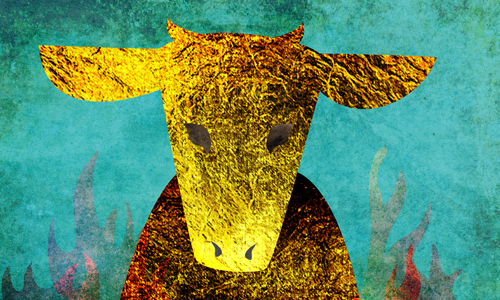
“Okay,” he says. “Remember all that gold you took with you on our way out of Egypt? The gold that belonged to your slave masters? Bring it all to me, and we will melt it down and turn it into a big golden BULL.” And that’s what they did. When the people saw the magnificent golden bull created out of the wealth of their former captors, they declared “THIS is our God, who brought us out of Egypt!”

Ironic, isn’t it, that the people claimed that the bull made of their captors’ own gold was the God who liberated them from those very chains?

Aaron seems like he has realized what a bad idea this was, and so he tries to mediate the clear violation of both Commandment #1 and Commandment #2 by declaring that this new golden bull was ACTUALLY a tribute to the REAL God. He built an altar before it and planned a big festival for the next day, trying to convince the people (and himself?) that they were actually worshiping the Lord and not some golden calf made of stolen gold from their slave masters.

The next morning, the people, delighted with this development, brought sacrifices, burnt offerings and food, and sang and danced all day long. Their boredom and restlessness had been relieved! They had something tangible to worship! Who cared if it was just something they’d smashed together from the remnants of their old lives? Who cared if this golden bull was nothing more than crumbs from the table of their Egyptian masters? The idol and the feast and the dancing sure did distract them from this infernal WAITING on Moses and God to work out the details of their new lives. If they were gathering gold and melting it down and building an altar and singing and dancing and creating this display of pious worship then they didn’t have to think about the unending wait and the infernal wilderness. Relief, finally!

But God – even though She’s up there in the cloud, immersed in architectural details and interior design for the Tabernacle – is still paying attention. And God is not pleased.

“MOSES!” God says, “do you SEE what your people are doing down there?” God does the thing that parents do when their kid is acting out: “that’s YOUR child!” God says to Moses: “hurry down, for YOUR people, whom YOU brought out fo the land of Egypt, are showing themselves. We JUST agreed on this covenant and I turn my back for one second (which apparently equals forty days in human time) and they go and violate it! Get down there and fix this. I’m so mad I could annihilate those Israelites here on the spot! What good is having an entire people I call my own if this is how they’re going to behave? I’m going to destroy them. Come on, Moses, I’ve raised up a great people before – remember Abraham and Sarah? I’ll just do that again with you. Let me destroy this batch and we’ll start fresh.”

Moses, though, argues for the Israelites and reminds God that if God destroys the Israelites for violating the Covenant then God would, ahem, ALSO be violating that covenant. “Let not your anger blaze forth against your people, God,” Moses says. And the Lord changed His mind.

Did you catch that bit? God changed God’s mind.

I love that the way Moses convinces God to forgive the Israelites and persist in this new relationship is to remind God that a covenant requires commitment from both parties. I love that God gets so angry, and I love that God chooses relationship over annihilation. I love that God could have – could still – done otherwise but chooses, over and over and over and over again to be faithful and forgive, to persist in attempting to be in communion.

Because we sure do keep testing God’s patience.

How many times have God’s people gotten restless, needed a distraction, and created idols out of the leftovers of evil? How often do we choose to worship things we’ve made instead of God, who made us?

I’ve been reading about Confederate monuments and the evil ways that white Americans have imbued them with Christian importance. Christian ministers blessed and commemorated flags and statues and stained glass windows. In the National Cathedral, until just a couple of years ago, Confederate Generals Stonewall Jackson and Robert E. Lee – men who spent their lives fighting to keep human beings enslaved – were depicted in ways that evoked both Moses and Jesus. Leftovers of evil, enshrined in our places of worship.

I’ve been listening to friends and family explain why they are voting for Donald Trump and excited about Amy Barrett as the Supreme Court nominee – willing to bow down at the altar of ego and evil in order to protect laws against abortion. Instead of worshiping the God who made us, selling our souls in order to worship a political system of our own making.

Idols aren’t always so obvious, though. What Aaron did – wrapping the idolatry of the golden calf in pious language and festival, pretending that it was simply an innovative way to worship God – is still real, today.

I wonder if this kind of painting over our human infidelity with propaganda is what we do when we value worship rituals over God’s commands to love our neighbors.

I wonder if we are actually practicing idolatry when we spend our money on capital improvements instead of making sure the hungry are fed.

I wonder if we are melting old evil down into golden bulls when we spend more time watching and obsessing and dissecting the current political theater than we do keeping sabbath, spending time in prayer, or honoring our elders.

Idolatry is slippery – that’s why it’s so hard to avoid. And we are in the wilderness, nearly desperate for some distraction from our confusion and pain. We are restless and prone to immediate gratification. It’s part of being human.

Thank God, then, that our Creator, the one with whom we live in Covenant, the one who brings us out of bondage and promises us freedom, abundance and eternal life chooses, over and over, to forgive, to persist, to make this relationship work instead of annihilating us and starting over.

When Moses and God do finally come down from the mountain, God announces God’s self in this way:

“The Lord! The Lord! A God compassionate and gracious, slow to anger, abounding in kindness and faithfulness, extending kindness to the thousandth generation, forgiving iniquity, transgression and sin…”

Thank God, this God, a God who is compassionate and gracious and slow to anger and abounding in kindness. Thank God that THIS is the God with whom we live in covenant relationship. Because we are not great at wandering in the wilderness, not great at waiting, not great at entrusting our existence to something other than of our own making.

Here we are in the wilderness of today, tempted to melt down the evils of our past and keep worshiping them, keep being bound by them. Thank God that even when we give in, even when we cannot handle one more day of waiting and watching, even when we break the covenant…that God has decided to forgive us, to re-direct us, to invite us, again, to join in this newness of life together where we worship God and God alone.

May it be so. Amen.
What Should You Read Next? (A fundraiser for Camp Bethel)

My beloved church camp in the Blue Ridge mountains lost a lot of revenue this year, like so many of our beloved institutions. In addition to cancelling summer camp for the first time in 92 years, their big fall fundraiser, called Heritage Day, is cancelled, too. So, folks are getting creative in the ways we raise money. Instead of a big one day festival where good church folk sell crocheted washcloths (which my grandma did for many years) or homemade applebutter (cooked in a copper kettle over an open fire all night long) or hand-pieced quilts or preacher cookies (my sister makes the best, BTW) or hand-tatted lace or country ham biscuits or kitschy wreaths or pinto beans or potted mums or fried apple pies or hand-knit scarves or sausage gravy (good GRIEF, I love autumn in the mountains)…we’re trying out some new things.

I have never been great at handicrafts, and while I can hold my own in the kitchen, my buttermilk pie will never live up to the ones up for sale at Heritage Day. Even though I’m a bona fide lady preacher, my church lady status is…lacking. I’m not great at crafting or baking but I DO read a ton of books. And I LOVE to tell other people what they should read.

So, I’m taking a page from my favorite podcast (What Should I Read Next, hosted by Anne Bogel), and offering homemade, from scratch, personalized, artisanal book recommendations! For you! For as little as a $5 donation to Camp Bethel.

Here’s how it works:

  1. Make a donation – either by sending money to me through PayPal (danacassell@gmail.com) or directly to Camp on their website. I’m planning to match the total I raise, so if you give directly, be sure to let me know how much you donated.
  2. Fill out this form, telling me three books you love, one book you hate and what you’ve been reading lately, and I’ll recommend three books that seem up your alley.

If you’re curious what kind of reading I do, you can check out my Goodreads page. If you want to see how it works, you can see what I recommended to Callie. If you don’t read books or don’t really care which ones I think you’d like, you can just make a no-strings-attached, tax-exempt donation to Camp Bethel.

Questions? You can comment here or email me at danacassell at gmail.com.

What Should You Read Next? (Callie’s Recommendations)

Callie loved:

An Altar in the World, Barbara Brown Taylor

Maybe You Should Talk to Someone, Lori Gottlieb

Wow, No Thank you, Samantha Irby

Callie hated:

Zen and the Art of Motorcycle Maintenance

Callie wants to read anything other than grad school books on research design and evaluation!

Dana’s Recommendations!

  1. Braiding Sweetgrass, Robin Wall Kimmerer
  2. Kitchens of the Great Midwest, J. Ryan Stradal
  3. Good Talk, Mira Jacob

I’m new at the book recommending game, and this one might be cheating a little since I’ve been swapping book suggestions with Callie for over a decade! Her three favorites were all non-fiction, with rich, funny writing from authors whose voices are clear and distinct. Braiding Sweetgrass is gorgeous “ecological non-fiction,” weaving indigenous custom and nature writing. Kitchens of the Great Midwest is fiction, and Stradal’s writing is funny and a little eccentric and I think it fits the pattern of quirky, clear-voiced things (I’m worried I’ve already recommended this one to Cal!). I haven’t actually read Good Talk yet, but it’s a new graphic novel about immigrants and families and I mostly want to hear Callie’s take on it!

(This book recommending format is from Anne Bogel‘s fantastic podcast, What Should I Read Next. I’m sharing recommendations as a fundraiser for Camp Bethel. You can get your very own personalized recommendations by making a donation and filling out this form!)