since you, too, were once immigrants

A couple of weeks ago, when the President issued an Executive Order that drastically changed our country’s policies toward immigrants and refugees, I changed our church sign out by the road. The text is still there: “Love the immigrant as yourself, Leviticus 19:34”
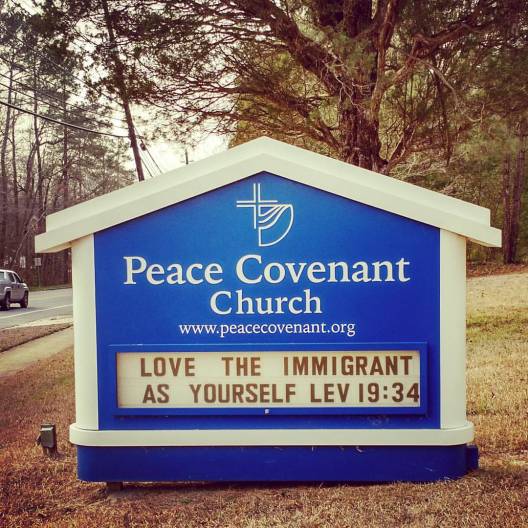
16602216_10101545366080807_8337296771235041943_o

The biblical command to offer hospitality to strangers is a thick thread throughout the entire witness of scripture. Some version of the formulation to care for foreigners, sojourners, immigrants and aliens shows up in Genesis, Exodus, Leviticus, Deuteronomy, Numbers, Zechariah, Psalms, Ezekiel, Malachi, and Jeremiah, just to get started. Jesus tells story after story of how being faithful includes caring for unknown neighbors and strangers – the Good Samaritan, the Woman at the Well, his own consistent care for those both within and outside of his proscribed social circles. In Hebrews 13, we’re told that we ought not neglect hospitality to strangers, since that by doing so, some have entertained angels without knowing it.

Hospitality is one of the strongest, most obvious and impossible to ignore themes – if there can be such a thing in such a varied and complicated witness – of scripture.

And still, when I put that sign up, it was not met with unanimous approval among our Christian sisters and brothers.

That’s probably not surprising, given how the public conversations among people of faith are going these days.

I shared a photo of our sign on Facebook, and a friend shared it to his wall. A discussion ensued, there, with some arguing that the sign was “political and not spiritual,” that it was disingenuous to quote that particular verse of Leviticus without including the verse a few before that forbids men from cutting the hair on their foreheads, that if we weren’t going to follow the hair-cutting commands then we really couldn’t be expected to follow the ones about hospitality.

I explained that I chose this scripture from among the dozens and dozens about practicing hospitality because of the formulation: love the immigrant as yourself reminds us immediately of Jesus’ words in Mark to “love your neighbor as yourself.” Immigrants and refugees are, in fact, our neighbors.

The explanation was not sufficient for this brother who was upset about the sign, and seeing as how I did not know him, we left it at that.

But the conversation stuck with me, especially as the larger political realities have continued to move toward exclusion instead of embrace, walls and deportments instead of compassion and hospitality. In these days, casting our lot on the side of God’s clear and repeated command to practice welcome and hospitality has become a rather radical act.

//

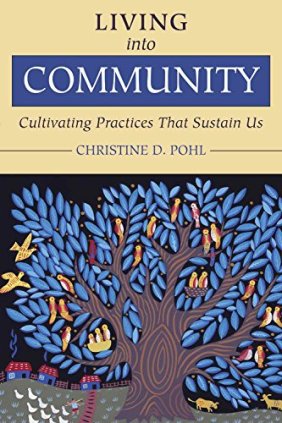
This is the last week in our series on Living Into Community, and hospitality is the last practice that Christine Pohl offers as foundational for sustainable community life. We explored three other practices: gratitude, making & keeping promises and truth telling. Pohl says that all of the practices are intertwined, that each requires the other three to be embraced fully. Hospitality, she says, is the result of a healthy community that has already committed itself to practicing gratitude, promise keeping and truth telling.
51kcbk6jlrl

Often, we hear about hospitality as an industry or an enterprise. The Hospitality Industry – full of hotel and motel chains, businesses invested in making and keeping travelers comfortable, for profit. But biblical hospitality is not a profit-motive endeavor. Biblical hospitality is part of a community’s life lived in response to the hospitality and grace we experience as people of God.

All of those biblical calls to welcome the stranger hang on this interesting motivation: “welcome the stranger, therefore, since you were once strangers in Egypt.” “Do not oppress the foreigner, since you were once foreigners.”

The scriptures call on God’s people to remember that they, too, were once immigrants and refugees, forced from their land and exiled into the wilderness, into an unknown land and required to rely on the kindness and hospitality of strangers. They are to practice hospitality not only because God requires it of them, but because they know, from immediate communal experience, what it feels like to be far from home, vulnerable and afraid, dependent on the compassion and care of strangers.

Faithful hospitality is not a means to an end. We are not called to be a welcoming church so that we will grow, or so that we can convert or save others. We are not called to Christ-like hospitality in order to achieve some measurable result. In fact, the practice of hospitality might actually deplete us – energetically, financially, relationally. It might not have a huge pay-off on paper.

The practice of hospitality is an end in its self. “Hospitable communities,” Christine Pohl says, “recognize that they are incomplete without other folks but also that they have a ‘treasure’ to share with them.” We practice hospitality because we know that strangers and neighbors have immense gifts for us, and we for them. We practice hospitality because, like the Israelites, we have known God’s welcome and are compelled to share that kind of welcome with others.

//

Our text this morning is from Revelation. Our Sunday school class spent a month studying the letters to the churches in the beginning of Revelation, so some of you might remember that these verses come from the letter to the church in Laodicea. In each letter, John shares commendations and condemnations for the particular church. Laodicea, however, wasn’t commended for anything. They only got condemnations – for being “lukewarm,” for thinking that they were rich enough to save themselves, that they were completely self-sufficient and needed nothing. Karen, when she taught our class, told us that the church at Laodicea had suffered a destructive earthquake and refused aid from anyone else, choosing instead to use their own considerable riches to rebuild.

John writes in the letter:

17 For you say, ‘I am rich, I have prospered, and I need nothing.’ You do not realize that you are wretched, pitiable, poor, blind, and naked. 18 Therefore I counsel you to buy from me gold refined by fire so that you may be rich; and white robes to clothe you and to keep the shame of your nakedness from being seen; and salve to anoint your eyes so that you may see. 19 I reprove and discipline those whom I love. Be earnest, therefore, and repent. 20 Listen! I am standing at the door, knocking; if you hear my voice and open the door, I will come in to you and eat with you, and you with me.

Somehow, the church at Laodicea had decided that they were just fine all by themselves, that the didn’t need anything or anyone else. But John is quoting Jesus, who says that they need to repent, to acknowledge their neediness, and, when they hear someone standing at the door, knocking and asking to be let in, they ought to practice hospitality: invite them in, eat with them, discover what it is they might actually be lacking but had no way of knowing when they’d isolated themselves.

//

Christine Pohl writes that “communities that practice hospitality discover that one of the most precious resources they have to share with people is their fellowship and friendship. More than offering ministry or services to ‘those in need,’ they welcome people into a common life.”

Hospitality is not something we do because we are the privileged and others are in need. Hospitality is something we practice because we know that we are incomplete and need the other – the stranger, the immigrant, the refugee – to make our community complete. We practice hospitality because we need one another, even the other that is different, even the other that we don’t understand, even the other that makes us a little fearful.

This kind of hospitality – practiced out of humility and faithfulness – is hard to do. It requires us to re-think our motives. Were we being welcoming because we wanted to change that person? Were we practicing hospitality because we thought it might improve our attendance numbers? Were we trying to make hospitality into a program, an accomplishment, a checked-off box on our discipleship to-do list?

Henri Nouwen, a Catholic priest and spiritual author who spent a portion of his life working in the L’Arche community, where people with disabilities live alongside assistants in intentional community, said:

The paradox of hospitality is that it wants to create an emptiness, not a fearful emptiness, but a friendly emptiness where strangers can enter and discover themselves as created free; free to sing their own songs, speak their own languages, dance their own dances; free also to leave and follow their own vocations. Hospitality is not a subtle invitation to adopt the lifestyle of the host, but the gift of a chance for the guest to find his own.”

This is hard to do. It is hard to be hospitable in a way that creates empty space for a guest to find their own way, to offer support and welcome while the new person is singing unknown songs and speaking unknown languages. It is hard, but it is the work we are called to do. It is the gift we are given to live out.

//

A couple of days ago, I got an email from Jourdi at Church World Service. Our congregation has been discerning and working toward partnering with CWS to help practice hospitality with recently resettled refugees here in Durham, but the Executive Order threw all of those plans and commitments into chaos. Several of us have been trained, but we assumed the partnering with a refugee family would be on hold indefinitely as the process spun through the political chaos.

But, it turns out there is a family here in Durham in need of some hospitality and friendship. We’ve been matched with a family of five, living in Durham and in need of friendship and English as a Second Language help and…hospitality.

At the training for CWS volunteers, Jourdi emphasized that our job is not to do things FOR our refugee neighbors, but to enable and empower them to do what needs to be done themselves. Our purpose, in volunteering this way, is not to change these new friends, or to offer some sort of paternalistic caregiving for them. Instead, we are to be friends, to share welcome, to leverage our particular privilege as English-speaking natives of this place so that they might find some space to find their own way here in this new life.

I will share more details as I get them. Only those of us who have been through the training with CWS are able to interact with the family, so if that had been on your list of possible ways to live your own faith journey in the midst of these crazy political times, I suggest signing up for the next training. If you’re not able to be trained for direct service, CWS is also in immediate need of volunteers to advocate on behalf of refugee resettlement, as well as immediate financial assistance, since their funding comes through federal grants and the federal commitment to refugees is on particularly shaky ground these days.

//

That brother who argued with my choice of scripture for our sign out front said that the message was “political and not spiritual.” I disagree, deeply. Practicing hospitality is a deeply spiritual practice, born of our own faith in the God who first welcomes us and then sends us out to welcome others. The fact that following God’s command to practice hospitality has become a radical political act says more about the direction of our country than it does about the direction of our discipleship. We are following God’s command to welcome the stranger, to love the immigrant, to show hospitality to the refugee among us, because we were once strangers in a strange land, ourselves; because God has welcomed us into the abundance of God’s community of love, and we are gifted this opportunity to share that welcome.


made new

Remember all those fables about truth telling that you heard as a kid?

There was the story of The Boy Who Cried Wolf, about a boy who lost all credibility when he carried on about a threat that wasn’t there, so that when a real wolf did come along, no one believed him.

There’s the story of Pinocchio, whose nose grew longer and longer each time he told one of his many lies.

There’s the story of The Emperor’s New Clothes – when swindlers lied to the Emperor about weaving a magnificent cloth that only those of noble breeding could see and all the officials, including the Emperor himself, lied about being able to see it in order not to feel shame about their own standing, until a child points out the totally naked Emperor marching in his own procession.

And, there’s the story of George Washington and the Cherry Tree. When Washington was six years old, he received a hatchet as a gift, and in his excitement, ended up cutting down his father’s cherry tree. When his father confronted him, young George fessed up immediately: “I cannot tell a lie. I cut it down with my hatchet.” And his father, instead of punishing him, pulled him into a hug and said that his son’s honesty was worth more than a thousand trees.

There are dozens more – telling the truth is a pretty universal standard in training up children to be moral beings.

And, telling the truth is a pretty universally understood aspect of basic human character. Honesty is a standard value. And yet, we are surrounded by people who are stretching, spinning, obscuring, halving or even straight up disregarding the truth. Telling the truth seems like a basic part of morality, but honest people seem fewer and farther between.

This is the third week of our series on “Living into Community,” practices that create solid foundation for community life. We’ve explored the practice of gratitude and the practice of making and keeping promises, and we’ve come to the third foundational practice for communal life together: telling the truth.

At first glance, telling the truth seems like a pretty simple practice: be honest. Don’t lie. But Christine Pohl, in her section on truth-telling, draws out several interesting aspects of honesty. If we are committed to truth telling, for instance, does that mean we are always compelled to share everything we know? Is it lying if I omit certain details in a story? Does being honest mean that I have to spend all my time doing that ‘telling the truth in love’ calling out sort of thing? And why might it be, exactly, that we are so often tempted NOT to tell the truth?

For Christians – and for those of us seeking to live out our Christian convictions in a community, like this congregation – honesty is rooted not only in the value of truth-telling for the health of our relationships and work, but also in the call to live a transformed life.

//

In our text for today, Paul is writing to the Colossians about living transformed lives. Apparently, the people in the church at Collosae were struggling to keep the faith in the face of some spiritual troublemakers who insisted that faithfulness was really about becoming more and more spiritual – less and less connected to the earthly realm and more and more in touch with the mystical, ephemeral realities of existence. Paul is writing to the Colossians to encourage them in their everyday practices of faith. How you act, here and now, is important. It is this way of conducting yourselves among the rough and rowdy realities of earthly life, he says, that makes up a life of faithful discipleship.

So, instead of ignoring the realities of day-to-day life and trying to be all disconnected, floating around on clouds and acting self-righteous and better-than-thou, the Colossians would be better off to consider what life in Christ would look like in their everyday dealings at home, at work, in their neighborhood.

Among the things that they should watch out for, according to Paul, are sexual immorality, wrongly-ordered desires, greed, anger, wrath, slander and malice. Those behaviors are part of the old self, inappropriate for people who have found in Christ an entirely new way of being together in the world. “Do not lie to one another,” he says, “seeing that you have stripped off the old self with its practices and clothed yourself with the new self, which is being renewed in knowledge according to the image of its creator.”

Don’t lie, in other words, because you are now aware of an entirely different way of being!

Don’t lie, in other words, because you know, now, better ways to treat one another.

Don’t lie, in other words, because this new self is grounded in a reality where lying serves no purpose.

Don’t lie, in other words, because your identity is rooted in the one who IS the truth.

//

An interesting psychological study from a couple of years ago examined the effect of those old fables about honesty on the willingness of children to tell the truth or not. Kang Lee, at the University of Toronto, conducted a study where children aged 3-7 were in a room with their backs to an unseen toy. The researchers played an animal sound associated with the toy and asked the kids to identify what it was. If they guessed right, they got the toy. After a couple of rounds of the game, the researcher would put a new toy on the table behind the child, ask them not to cheat by turning around and looking, and then leave the room for a moment.

A few minutes later, the researcher returned, read aloud a short version of one of those honesty fables, and asked the kids whether or not they had peeked. A camera had recorded the kids, so researchers knew if they were fibbing or not.

It turned out that when the story before the question about peeking was the control story – The Tortoise and the Hare, not about honesty at all – kids told the truth about 30 percent of the time. When the story was Pinocchio, a story where lying has pretty grave consequences, the kids told the truth a little more often, at 35 percent of the time.

But, interestingly, when the story was the one about George Washington and the cherry tree – a story where honesty gets rewarded – kids told the truth a whopping 50 percent of the time.

The researchers concluded that kids are more likely to tell the truth when the fables are ones where honesty is rewarded instead of ones where lying is punished. In other words, instead of scaring the stuffing out of kids by threatening them with punishment, it might be better to explain the benefits of the desired behavior. It might be better to talk about how honesty is valuable rather than about how lying is hurtful.

//

As we read a new report each morning about the lies of politicians and a new accusation every afternoon about the lies of the media, it seems especially important for us, as a body committed to being made new in Christ, to be able to articulate the reasons honesty is a bedrock value of our life together. Of course, setting the record straight and being smart about lying leaders and media spin are important, too, but that often seems to me like an endless shell game, as each exposed lie seems only to uncover a dozen more that were hiding beneath it.

Instead, why don’t we begin to think, together, about why truth telling is important for US, for our life together HERE, for our own personal discipleship and transformation into being clothed in this new way of being.

//

In her writing on truth-telling as a sustaining practice for community, Christine Pohl offers a list of reasons why we might be tempted to lie, reasons that can begin to make plenty of rational sense when we’re operating on the assumptions of the world around us instead of the assumptions of this new life in Christ:

To avoid punishment

to protect oneself from harm

to obtain a reward for oneself

to protect or help another person

to win admiration from others

to get out of an awkward or embarrassing social situation

to maintain privacy

to exercise power over others

to fulfill social expectations

to have fun


But in the light of a total transformation, a new life found in the freedom of salvation and resurrection, many of these reasons dissolve into the ether.

If we are people who believe that death is not the end, for instance, we are less likely to need to protect ourselves from harm.

If we are people who understand that justice and judgment come from the God who is on the side of the vulnerable and the oppressed, then we are unlikely to act to avoid punishment from other authorities.

If we are people who find ourselves convicted that our worth and value is rooted in the reality that we are created beings, deeply beloved by the one who created us, then we are less likely to lie in order to win admiration from others.

If we are people who follow the one who exemplified the power of servanthood and taught that the last will become first, we will be much less likely to need ways to exercise power over others.

If we are people who have been so transformed as to recognize that the social conventions and cultural expectations of our day and time are human constructs, we’ll be less likely to lie in order to avoid embarrassment or awkwardness or perpetrating a social faux pas.

The point is: for Christians lying isn’t just wrong. Lying isn’t just a bad choice with dire consequences. As a Christian, living a transformed life in the light of the life, death and resurrection of Jesus Christ, lying is simply…unnecessary.

Of course, that doesn’t automatically clear up each and every contingency for each particular situation in which we might be tempted to choose a lie over the truth.

We might still be embarrassed. We might still face punishment. We might still commit a social faux pas, and we might end up losing the admiration of others. To say that lying is unnecessary in the transformed life doesn’t mean that there are no longer consequences for telling the truth. Honesty is still a hard value to practice with consistency.

But, as Paul tells the Colossians, we are at this very moment “being renewed in knowledge according to the image of its creator.” The struggle is real, and the struggle is worth it. Being honest and truthful makes us more like the one who created us, the one who IS The Truth (two capital Ts).

//

Christine Pohl makes a point to say that truth-telling is not always about naming the negative realities or “calling someone out” when we notice them acting without integrity. Telling the truth also involves naming the gifts and graces present in one another, present in our lives together. Telling the truth requires the patience and attentiveness to read the context, be aware of the situation, and share – in love and gentleness – the truth of any given situation.

When we practice truth-telling both ways – taking time and care to name the gifts as well as the failures in our life together – we build up the foundation of our community. We learn to trust one another and to expect an accurate reflection of reality from the sisters and brothers around us. When we need correction, we can look to one another to tell us. And when we need encouragement, we can find that here, too.

May it be so. Amen.

to save a life

February stinks. I’m late to this reality, I know. There’s Valentine’s Day, of course, a tire fire of a holiday if there ever was one for single ladies (although, these days I find so much pleasure in snarkily pointing out the original meaning of the day that it almost cancels out the heaps of commodity shame).

919e9119976455a55125b68bcb2dbb8e

But there’s also the regulation mid-winter blues, post-holidays, pre-spring-thaw. Add to that the weird, personal anniversary of Teratoma Steve, the tumor that stole 1.5 of my ovaries eight years ago and whom my body has chosen to memorialize by losing its ever loving mind each February and – a new one this year – the anniversary of a friend and mentor’s unexpected death.

February stinks.

In her book Leaving Church, Barbara Brown Taylor writes about a time when she was asked to speak, and the topic was “What’s Saving Your Life Right Now?” I love that question, and regret that I don’t ask it of myself more often. Anne Bogel at Modern Mrs. Darcy wrote a post about it a few weeks ago, and I’ve been making my list since then. So, in defiance of February, I present to you some things that are saving my life right this minute.

  1. What Should I Read Next Podcast!

This is actually the podcast connected to Anne Bogel and Modern Mrs. Darcy, and I learned about it when an author acquaintance of mine was a guest. Basically, Anne asks each (bookish, interesting, passionate about reading) guest to name three books they love, one that they hate, and what they’re reading right now. Then she makes recommendations based on their conversation.

The podcast feels like what life would be like if your best friend was a kick-ass librarian and every week  you sat down for an hour and got to talk about books with her. Anne’s conversation style is so soothing, and her guests are always really interesting women doing awesome things in the world. I am so smitten.


2. This song (and video!) by Ruthie Foster:

I’ve been working non-stop on a huge project with my friend and co-worker James, who also hosts a weekly folk/Americana radio show up in Michigan. The giant project is nearing an end, and James himself has been a godsend. I’m going to miss working with him, and I’m also going to miss his weekly music recommendations.


3. The ocean.

I live a mere 2 hours from the beach, and have been craving time at the water since Thanksgiving. Today was the first day I had a clear calendar, relatively healthy sinus system and an almost finished sermon since then, and I tell you what: I took advantage of it.

img_20170218_131000

I didn’t do much – drove out, sat on the sand, ate some shrimp, walked in the waves, drove home. But something about the sand on my sad winter feet and the wind whipping through my hair and the constant pulse of the tide in my ears did what I hoped it would do: I feel scrubbed clean, exfoliated outside and in. I felt my shoulders drop and my mind unclench itself. I still have a nasty cough, my sermon is still only almost-done, but man am I glad I finally gave in to that persistent desire.


4. Sweet Potatoes and Brussels Sprouts

Seriously. I don’t know what vitamin, mineral, anti-oxidant super food combination is in those two vegetables, but I cannot get enough. A little olive oil, a little kosher salt, roast ’em in one pan for 20 minutes: BAM. Dinner. Three nights a week.


5. Friends.

Making friends is hard work. I’ve got beloveds all over the country, but finding good people who live close by has always been a challenge. I could list a long chain of reasons particular to my personal situation (introversion/ministry/singleness/former transience/etc.), but by now I’ve had the conversation with so many people – young, old, male, female, married, single, kids or not – that I’m convinced it’s just a hard thing to do for everybody. I’ve been in Durham for a year and have been consciously trying to invest in the place and in community here. It is slow going. It takes time, commitment, a ton of energy, and persistence.

But! Things are starting to turn a corner! Last week, I had two separate meet-ups with new potential friends and at both of them, someone other than me asked if we could make the hang-outs a monthly occurrence. This is in addition to several other burgeoning friendships in the last couple of months and – oh – it makes such a difference. Friends.


6. FRANDOG


I mean, obviously.

An entire year with this nugget, and I am wrapped around her tiny little paw. She spins in frantic, ecstatic circles whenever I come in the door, has licked tears off my face on multiple occasions and, when I wake up in the morning, she crawls lazily out from under the blankets where she’s burrowed during the night, gives me a good morning kiss and then plops herself down again, head on the pillow inches away from mine, eyes wide open, waiting to discover what kind of adventure this new day will hold.

courage, 2017

A couple of weeks ago, I planned a “star word” activity for my congregation. Each person chooses a small star with a word printed on it. The word can be a way to pray, reflect, or grow through the year. It’s a way of celebrating epiphany – remembering both the star that the magi followed toward the manger and reminding us that we are in the liturgical season of light, even though the days are still short and the nights are still dark.

A southern snowpocalypse hit the weekend of Epiphany, and we ended up cancelling worship. I offered to choose stars at random for anyone who emailed or texted me for one, and almost everyone did.

As I prayed for each other person and chose their stars at random, I was surprised to see how many star words matched so perfectly with the personality of the recipient. Someone I know as really humble got ‘humility.’ Someone else, a delightfully zealous and energetic person, got ‘zeal.’ I decided to choose a word for myself, hoping that it might be an affirmation like that. I flipped over my word, and I’ve been pouting about it ever since.

img_20170108_120558

Courage.

Ew.

I am not a very courageous person. I have done some brave things, and sometimes surprise myself that the shy, quiet bookworm who didn’t really like leaving the house as a kid is now a fully independent, single adult woman who pays her own bills and changes her own windshield wiper blades and meets new people and cultivates relationships for a living and has traveled across oceans by herself.

But courage is not at the top of the list of Dana’s Virtues.

I am terrified of many, many things. I trust routine and get anxious when it is disrupted. I hate being forced out of my comfort zone. I need a while to decipher any new challenge, and even longer to decide what to do about it. I do not like being forced into threatening situations.

So, I spent the last few weeks whining and pouting and arguing with myself. I even turned the little wooden star upside down on my desk so I didn’t have to think about what a coward I usually am.

But then, after a few weeks, I started thinking about the people I know who ARE courageous. And I started thinking about the incredible things that they’ve done that wouldn’t exist without that bravery.

And then, I started thinking about all the things that terrify me. Some of them are too huge to even consider right now, but I did begin to realize that there are tiny, everyday things that I am afraid of, and that if I start there, maybe I can begin practicing courage. Maybe if I cultivate courage in small things, whatever this year brings that requires the virtue won’t feel so insurmountable. I decided to challenge myself.

This list feels small to me, but I’m going to complete it, anyway. It’s a weird reality out there in the world today, and I need to be doing something about it – even if it’s just practicing myself into a virtue that I expect to be needing more of sooner rather than later.

THE LIST (for now. Let’s call it Courage: For the First Quarter)

Walk to the library.

This is a ridiculous thing to fear, I know. I have walked to the library at least twice a month for the last year. The main branch of the Durham library system is less than a mile from my house, and it is huge and full and has that particular smell that old libraries harbor. But on January 1, the main library closed for 2 YEARS for renovations.

There is another branch exactly the same distance from my house, in the opposite direction. The walk from here to there is not like the walk from here to downtown. It takes me past strip malls with bars on the windows, at least three permanently stationed homeless guys with cardboard signs asking for money, a liquor store, a pawn shop, and a payday loan enterprise. According to the local police, there were six crimes committed this week between my house and the new library. Zero between my house and the old one.

A year ago, when I moved to downtown Durham, I did it intentionally. I wanted to live in a place where I could not easily ignore my white privilege. I turned down suburban apartment complexes in favor of this downtown loft so that I could walk more, interact with people on the sidewalk regularly, know my neighborhood at a pedestrian level, and generally be less of an isolated middle class suburban white lady. I am probably only succeeding at those intentions 30-40% of the time. I still do my grocery shopping elsewhere, I get in my car far more often than necessary, and I still avoid certain blocks on foot during the day; all of them at night.

But constant access to a car and the ability to drive is a privilege that I rely on too often. I have friends without either, and have been impressed and inspired by the courage they use every day to walk where they need to go because that’s the only way to get there. Courage: walking to the library. Regularly.


Call my congresspeople.

Again: not exactly scary. But I am terrified. I have looked up all their numbers, I have researched scripts for what to say and how, I have given myself pep talk after pep talk, but I have not yet been able to participate in this particular aspect of democracy. Yesterday, I picked up my phone, entered Senator Burr’s number, threw it down and sent an email instead.

I hate the phone. Detest. I don’t like answering calls and I dislike making them even more. Always have, expect I always will.

And also: politics has never been my thing. In fact, I have studiously avoided politics out of what I believed to be theological commitment to an alternative way of being. I have been ambivalent about voting, decidedly against spending time, energy and money on national politics in general and, at times, quite smug about it all. I am afraid that doing this one thing will drag me into an inescapable pit of political awfulness.

But these are weird and convicting times and both my worldview and my theological one have shifted in recent years. I voted in the presidential election. I am horrified by the results. I elected these representatives, I want them to represent me in their offices and with their votes. So, the least I can do is call.


Lead a conversation about sexuality at my church.

This one terrifies me. I am not scared of leading conversations – I have experience at that, even tense and important ones. I am not scared of my congregation, either – they are some of the most genuine, hospitable and thoughtful people I know. I’m not even scared of discussing sexuality – it’s an elemental part of who we are as humans, and the impact of these conversations has immediate spiritual and political impact.

What I am scared of, I guess, is the combination of the three things: sexuality, church, and leadership. Specifically, being a leader in the church when we talk about sexuality. Colleagues have lost their credentials for not much more. Not long ago, my integrity was questioned because I have an opinion about it. And I know that people I love and respect – and who are in positions to complicate the standing of both my congregation and my credentialing – disagree with me.

But I also remember the unimaginable courage of my friends who have done this – led a conversation about sexuality in the church – without the privilege I enjoy of being straight and cisgender. That’s bravery, right there: to put your own safety on the line in order to prod the community toward discernment. If they can do that, surely I can do this.

Okay. The list was actually a lot longer, but my stomach is in a few knots and my anxiety level is rising just having reflected – theoretically – on these three.

Courage. Courage. Courage.

I can do these (not very) hard things.

sowers of delight

Sermon 1-22-17

Matthew 13:3-9

In today’s parable, Jesus is talking about a farmer, a gardener, someone going out to the earth to sow seeds.

My imagination immediately flashes back to my grandpa Bobby’s garden – a giant, empty lot in Roanoke where he spent his early retirement planting, tending and harvesting all kinds of vegetables and flowers. I remember planting beans with him and my cousins: we’d drive his big blue Ford pick-up truck over the bank and into the garden and, after he tilled the rows, we kids got handfuls of pink and white October beans.

I have a vivid memory of those seeds in my hands – such bright colors, for seeds. And they were slightly chalky, maybe from chemicals meant to prevent mold, maybe just because that’s how the seeds were. I remember the feel of a handful of beans, fillng my palm. I remember feeling very useful, to be planting these seeds. And I remember feeling very important, to be here in the garden with all the adults.

We were clearly instructed about where those October seeds went: they did not get not thrown out willy-nilly, not discarded in the grass, not strewn about without any plan. Those beans went in these rows. And so, we walked, up and down those rich brown garden rows, dropping beans into the tilled rows, methodically, one after the other. I mean, most of the time. Most of the time we followed directions and dropped seed after seed into properly tilled and readied row. Most of the the time. We were kids, after all.

I am not a gardener. My thumbs are fairly gray – houseplants have a fifty-fifty chance of surviving in my apartment. But I have vivid memories of being in Bobby’s garden and dropping those chalky pink and white beans into the prepared rows.

And I have equally vivid memories of the end of the process – late in the summer, sitting on my grandparents’ back patio, my grandma JoJo with a big bucket of full-grown beans, pulling out a handful, snapping the ends off into a plastic bag and throwing the snapped beans into a pan to be washed and, later, canned. I remember the slow afternoons, the sound of those beans snapping, the conversation that flowed over and around the work.

And after the snapping and the washing came the canning, and eventually, later in the year, the eating. I hated beans for a long time – glad to plant and snap but reluctant to eat any of them: no limas, no half-runners, no pintos, no peas. Beans were gross.

How was it that I was so excited to be a part of the sowing and harvesting, snapping and canning but couldn’t bring myself to enjoy the delicious yield? I regret, these days, that I missed out on so much fresh, homegrown, manual-labor and love-infused food.

I’m not a gardener. But I did learn a thing or two from those summers with my grandparents. I learned about the processes of sowing and reaping, the way that hard work can yield nourishing food for the family. I learned where food came from – not only McDonald’s or Mom’s freezer, but from the ground. I learned that the food that sustained me and helped me grow was the result of someone else’s hard work, dedication and care.

I confess that I forget these lessons all too often – that my current state of health and welfare is, so often, the direct result of someone else’s hard work, dedication, and care, sown long, long ago.

In this parable, Jesus is talking about a sower. But this sower did not listen very well to Grandpa Bobby’s instructions. The seeds did not end up in the neatly tilled rows of the garden. Clearly, this sower has been neglecting her job – maybe playing over at the edge of the garden with her cousin Ashley instead of walking neatly up and down the rows, maybe distracted by her sister Leah’s dance routine over in the far corner, maybe distracted by her cousin Adam’s jokes in the next row, maybe running down the tree line to catch a glimpse of that deer and her babies that lived close by. The seeds aren’t ending up in the right rows! The seeds are all over the place, falling through the cracks in the sowers fingers, unheeded, neglected…wasted.

Or so we think.

jesus_christ_parable_of_the_sower_hand-painted_byzantine_icon_04

Jesus says that while the sower was out sowing, some seeds fell on the path and birds came to eat them.

Some other seeds fell on rocky ground, where nobody had tilled a safe, deep row for them. They sprouted, but since they had no roots, the sun’s warmth quickly scorched them.

Some other seeds fell among some thorny plants (squash, probably, or the rose bushes in the far corner), and the thorny plants grew up and choked out the seeds.

But some seed – some of it – did fall on good soil. And the seed that got in that good soil had INCREDIBLE results! Some yielded a ratio of a hundred to one, others a ratio of sixty to one, and still others a ration of thirty to one.

And, with that right there, this tiny, simple, weird little parable of the sower, Jesus says: “Everyone who has ears should LISTEN!”

Well, all right, Jesus.

I’ve got ears, so I’m listening to you.

But I don’t understand what you’re trying to tell me. I’ve been a sower of seeds. I’ve had those pink-and-white Octobers fall through my fingers, and I’ve had them drop deliberately into their prepared good soil.

So, what is it that you’re wanting us to HEAR, here?

Much of the interpretation of this parable ends up focusing on where the seeds fell. We could spend days and days trying to find ourselves in the seeds, figure out if we are the seeds who are on the road, or in the rocky ground, or among the thorns. We could spend months trying to decide if we’re the ones with shallow roots or being pricked to death by those annoying thorny people around us.

In fact, Matthew even goes so far as to include an explanation of the parable a few verses later, awkwardly inserting an interpretation for this parable, but not for every other one. Even in the text, the explanation feels awkward. It condenses the possible meanings into an awkward one-to-one correlation. You can almost hear Matthew talking to himself as he scratched out his gospel: “Oh, man, this is a WEIRD one, Jesus. They’re gonna need some interpretation for this one. I’m going to just go ahead and write out the key here, even though I KNOW you tell these stories so that they have as many meanings as there are ears that hear them…”

And, anyway, Jesus doesn’t ask us to explain the parable, or to understand it so we can file it away as one more idea, conquered and defined. No, Jesus asks us to LISTEN to the parable.

Well, when I listen, I find myself not so much curious about the seeds as I am curious about the sower.

What kind of gardener would toss the seeds about like that? What kind of bean planter would let so many beans escape the carefully tilled rows and end up tossed all over the place?

Maybe the sower IS like those little kids in my Grandpa Bobby’s garden, less intent on planting properly and more excited simply to be there, helping with the process, out in the sunshine and near the rich brown earth.

Maybe the sower is less of a perfectionist and more of an opportunist. Maybe the sower has so much seed that she can afford to toss it up in the air in celebration. Maybe the sower delights in a cousin’s companionship or a sister’s performance or a sighting of delicate wildlife more than she cares about the proper placement of each and every seed.

Maybe the sower is sowing, not out of necessity or fear that there won’t be enough, but out of sheer joy and abundance at getting to be part of the process. Maybe this is a sower who can afford to let the tiny, chalky seeds fall through the spaces between her fingers just for the enjoyment and wonder of the way that feels. Maybe this sower is far less concerned with keeping the rows straight and much more interested in sharing the seed with every nook and cranny of the place.

What if Jesus is asking us to listen, in this parable, not to the possibilities of seeds growing in various contexts, but to the possibility of becoming planters like this one – so caught up in the joy of planting, so delighted by the experience of joining the crowd of gardeners, so immeasurably excited to have that handful of october beans to share that we cease to worry about proper placement of the seeds, or the exact depth of the tilled rows, or the appropriate chain of command in the garden enterprise, or the coordinated timing of the harvest…

If that were the way gardening worked, I would certainly be more interested in taking it back up. If I could be a sower like little kid Dana was, celebrating the very opportunity to be a part of the enterprise, letting beans fall where they may, throwing a handful up in the air just to see them shower down…well, maybe my houseplants would survive a little longer.

But here’s the thing: In this parable, that IS how gardening works! It isn’t an efficient way of gardening. It’s not frugal or stingy or calculated, but the seed that does fall on good ground? Well, it yields 100 fold! It turns out that all that seed that dropped in other places wasn’t wasted after all. It was part of the process. It was part of the joy. The seed that grew in good soil yielded enough and more than enough. There was no reason to worry about scarcity after all. There was no reason to get angry at those clumsy sowers preoccupied with delight.

I am taken by this parable, taken by the possibility of becoming sowers of delight – less preoccupied with whether or not we are doing this faith thing ‘right’ and more interested in whether or not it is an undertaking of joy, delight and attentiveness.

This morning, our worship is focused on the mission resourcing campaign of the Virlina District. They’ve chosen this passage as their theme, and it seems fitting. Our call, in this parable, is not to worry about whether or not the church as we know it will survive these coming years, not to wring our hands about the proper placement of limited resources in the here and now, not to argue over the size of the rows or the exact placement of the seeds, but to be sowers of JOY – sharing what we have now where and how we can.

And if we sow this way, we might find – like I learned from all those hours spent with my grandparents in the garden and on the porch – that our hard work, dedication, care and JOY can become the things that create health and well-being for others we don’t even yet know.

Our job is not to perfect the rows. Our job is not to sow only in proven good ground. Our job isn’t even to worry about rocky soil or thorny plants or any other threats to the seed of the gospel that we are called to share. Our job is to be a sower like this one – to arrive joyfully at the garden, so taken by the opportunity to join in the planting that we cannot stop smiling. Our job is to sow recklessly, abundantly, trusting that the growth doesn’t depend on us, but on the one who gave us the seed in the first place. Here: have a handful of beans. There: there’s the garden where they’ll grow.

Go. Sow. Dance and shout with the joy of it.

A blessing, from Bishop Ken Untener, of Michigan:

It helps, now and then, to step back and take a long view.

The kingdom is not only beyond our efforts, it is even beyond our vision.

We accomplish in our lifetime only a tiny fraction of the magnificent

enterprise that is God’s work. Nothing we do is complete, which is a way of

saying that the Kingdom always lies beyond us.

No statement says all that could be said.

No prayer fully expresses our faith.

No confession brings perfection.

No pastoral visit brings wholeness.

No program accomplishes the Church’s mission.

No set of goals and objectives includes everything.

This is what we are about.

We plant the seeds that one day will grow.

We water seeds already planted, knowing that they hold future promise.

We lay foundations that will need further development.

We provide yeast that produces far beyond our capabilities.

We cannot do everything, and there is a sense of liberation in realizing that.

This enables us to do something, and to do it very well.

It may be incomplete, but it is a beginning, a step along the way, an

opportunity for the Lord’s grace to enter and do the rest.

We may never see the end results, but that is the difference between the master

builder and the worker.

We are workers, not master builders; ministers, not messiahs.

We are prophets of a future not our own.

#rendtheheavens Day 28

Day 28: HEAVENS

Luke 2:16 So they went with haste and found Mary and Joseph, and the child lying in the manger.

My aunt (hey, Trisha!) has been reading all these Advent posts, and when I saw her yesterday, she mentioned them. “Yeah, I said, it’s been great, because I’ve written every day! Even though some of them have been kind of…fume-y.”

I meant that some of these posts have been written with only the fumes of leftover energy and ideas during a high-energy season of church life. She heard “fuming.”

Also true.

The practice was meant to be cathartic, I think. Rend the Heavens or Fuck This Shit – the prompts were apocalyptic, texts of judgment and warning, reminders that the world has always been ending, that Jesus was no stranger to global upheaval and immediate oppression.

It served its purpose. I feel properly purged, emptied, vented, lamented, confessed. It has been a year of major changes for so many of us, and finding the time and space to name them and process them and accept them as the way things are going to be is important.

All of this grief, pain, despair, racism, misogyny, violence and political disaster is real, and all of it has very real consequences for very real people.

And also:

God is here.

Not just as a Spirit, not just as a clock-maker, not just as an inaccessible, far away father-figure, but here. In flesh. With us. In the midst of all the grief, pain, despair, racism, misogyny, violence and political disaster. God knows it. God lives it. God was put to death in one of those very real consequences for very real people.

And in some ineffable, cosmic, mystical way, that divine presence, that incarnation, that Emmanuel, that God who would choose to be here, with us, embodied and subject to the indignities of aging, family systems and gravity changes everything.

It means that none of this shit is the last word. None of this shit gets to exercise unmitigated power over us. None of this shit wins, in the end.

Love wins.

Those apocalyptic texts call God down from the Heavens to conquer foes, heal wounds, make a way where there has been no way. They call on God to change the King’s heart, lift up the lowly, throw the powerful down from their thrones, find the lost, serve the least, and guide all of us into the ways of peace. They call on God to work justice and salvation and mercy in places that have been without for so long.

And you know what God does?

God agrees. God answers.

God rends the heavens and comes right on down to do every one of those things.

God has done it – that’s what we celebrate today. God rent the heavens and joined us here, on earth, in flesh.

And God does it again and again and again.

Every time we lament, every time we confess, every time we learn some new truth or engage some new perspective. Every time we pray, every time we serve, every time we consider the flesh and bone of neighbors and strangers with care and compassion. Every time we – the Body of Christ – act as Jesus did, and every time we – the household of God – trust in God’s presence and power the heavens get rent. God arrives on the scene.

The trick is that it never looks the way we expect it to. That arrival rarely comes with robes and thrones and trumpet blasts. It’s quieter and more human. Silent nights, mangers, grubby travelers and emergency births. It’s not in the halls of power, but tucked away elsewhere, slowly building and growing like mustard seed, like kudzu, like lanterns being lit one by one.

And just like it’s important to lament and grieve and name the pain, it is equally important to watch and hope and seek out those glimpses and glimmers of heavens rent in two.

Here’s to a blessed Christmas season, on the lookout for shimmering lights, glowing and growing steadily

until the new dawn from on high breaks upon us,

giving light to all those sitting in darkness and in the shadow of death;

guiding all our feet into the way of peace.

10628209_10100764470367077_2397257818125103492_n

#rendtheheavens Day 27

Day 27: HELL

Galatians 3:13 Christ redeemed us from the curse of the law by becoming a curse for us—for it is written, “Cursed is everyone who hangs on a tree”—

I skipped a couple of writing days while I was in Roanoke celebrating with my family this week, and now it is the evening of Christmas Day, the end of all that Advent waiting, the celebration of God’s reign on earth in the form of a tiny little baby boy, and I have to write about hell and hangings.

I don’t know a lot about hell, and I don’t know a lot about hangings.

The first is because hell is a slippery, pseudo-biblical concept that no one living has actually experienced.

The second is because the history I was taught over the course of many (many) years of formal schooling conveniently left out most of the hangings that white Christians orchestrated, attended, adulated and encouraged in American history.

From 1880 to 1940, white American Christians lynched nearly 5,000 black Americans.

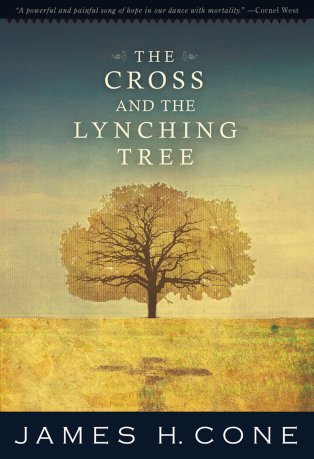
And they didn’t do it under cover of night, either. They were not ashamed of what they were doing and, like James Cone says in his book “The Cross and the Lynching Tree,” they apparently made zero connection between lynching their neighbors and the lynching of their Lord and Savior, Jesus.

Cone says:

71tl6zhn0zlUnfortunately, during the course of 2,000 years of Christian history, this symbol of salvation has been detached from any reference to the ongoing suffering and oppression of human beings—those whom Ignacio Ellacuría, the Salvadoran martyr, called “the crucified peoples of history.” The cross has been transformed into a harmless, non-offensive ornament that Christians wear around their necks. Rather than reminding us of the “cost of discipleship,” it has become a form of “cheap grace,” an easy way to salvation that doesn’t force us to confront the power of Christ’s message and mission. Until we can see the cross and the lynching tree together, until we can identify Christ with a “recrucified” black body hanging from a lynching tree, there can be no genuine understanding of Christian identity in America, and no deliverance from the brutal legacy of slavery and white supremacy.
I am astounded at the ways we lie to ourselves about the righteousness of our own behavior. Parties! People held lynching parties! And this history – the one I am learning, finally, now, the one that I resisted for so many years, the honest and painful one – makes me wonder how many ways white America is lying to ourselves still, today. How many ways am I lying to myself about the righteousness of my own behavior, right now?

God of truth and repentance, open my eyes to the ways I deceive myself, the lies I ignore, the false history I buy into in order to avoid confession. Wash me, so that I might be clean. Purify me, so that I might have the courage to confront the power of Christ’s message and mission.

#rendtheheavens Day 26

Day 26: ROLL(OUT)

Revelation 22:18-19  I warn everyone who hears the words of the prophecy of this book: if anyone adds to them, God will add to that person the plagues described in this book; 19 if anyone takes away from the words of the book of this prophecy, God will take away that person’s share in the tree of life and in the holy city, which are described in this book.

Everybody’s bidding good riddance to 2016, ready to roll on out and into a fresh, clean new year.

But things don’t look too promising for 2017, either.

Unless, of course, we really are hoping for an apocalypse.

Apocalypse means ‘uncovering.’ It’s not necessarily about explosive destruction, but rather about a revealing of the true realities underneath the supposed powers of the world.

I think that’s happening, and I think it’s painful and necessary.

Hope isn’t optimism, and it isn’t certainty. It is, like Rebecca Solnit says, admitting that we do not know the future. Confessing that we don’t know. Saying out loud that all our assumptions were wrong. Owning up to all the ways that we have been wrong, that we have been overconfident, that we have relied on our own power and safety and comfort instead of cultivating curiosity, humility, and openness.

I once got criticized for using the phrase “I don’t know” as a refrain in a sermon. I was a new preacher, and I probably didn’t wield the phrase very skillfully. But, years later, I am still committed to being that kind of honest in my preaching and in my life. I don’t know when the world ends, I don’t know how, I don’t know why. I don’t know what powers spin what consequences, or why god makes it to rain on the righteous and the unrighteous. I don’t know a lot. Sometimes that opens me up to a shit-ton of mansplaining after I confess it, and sometimes it opens the door for someone else to say “Thank God. I was so tired of having to pretend I knew when I didn’t.”

Jesus himself said that he didn’t know when the world would end, and that we really shouldn’t waste our time thinking about it.

Here’s where I think I’ll anchor my hope, these days: Hope in the things I do not know. Hope in the mystery. Hope in the irrational, illogical, inbreaking of something else. Hope in tucked away corners, like mangers and forgotten towns. Hope in totally unforeseen angles on old, old problems. Hope in reversals, restorations and resurrections. Hope in ways made where there was no way. Hope in a God who would choose to relinquish even the privilege of being DIVINE to be with us.

#rendtheheavens Day 25

Day 25: SCANDAL

Matthew 1:16-17 …and Jacob the father of Joseph the husband of Mary, of whom Jesus was born, who is called the Messiah. So all the generations from Abraham to David are fourteen generations; and from David to the deportation to Babylon, fourteen generations; and from the deportation to Babylon to the Messiah, fourteen generations.

Matthew’s genealogy is one of the best parts of the bible.

No, seriously.

I read a feminist argument recently, about the ways that in patrilineal societies, women get left out of genealogies. As if any of those begats would have been possible without women’s ovaries, wombs, cervixes, labor. The author alluded to biblical genealogies as a cardinal example of these patriarchal lists.

While it’s true that the begats do lend themselves to female erasure, Matthew is not falling for that old trick.

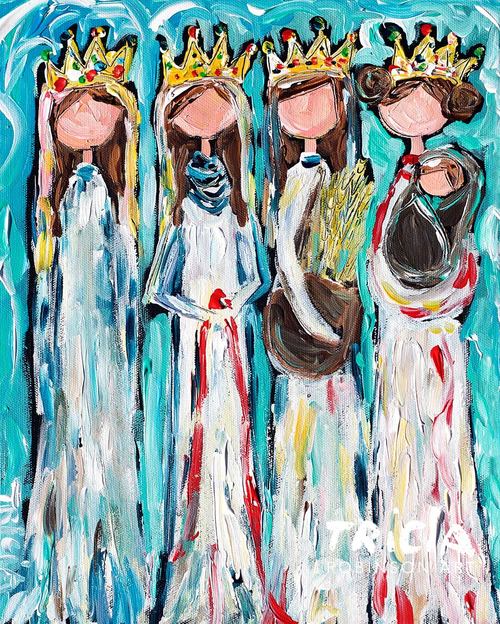
Matthew includes four women in the genealogy of Jesus.

Of course, there are dozens and dozens more who do get left out, erased from the collective memory, cut clean out of the narrative. But the genealogy of Jesus is not exactly as misogynistic as some might have us believe.

And these four women: hoo boy.

  1. Tamar: after her father-in-law refused to provide protection for her after two of her husbands died, she pretended to be a prostitute, intercepted her father-in-law on the road, got pregnant by him, and forced him into providing her protection as the mother of his heirs.
  2. Rahab: an actual prostitute who lent shelter and secrecy to Israelite spies who were plotting to take over the city of Jericho, winning herself and her family lasting protection once they gained control of the city.
  3. Ruth: wily widow who decided to stick with her widowed mother-in-law instead of returning to her own home and family, tricked a distant cousin into having sex with her and, again, offering inheritance, standing and protection for both her and her chosen family.
  4. Mary: unmarried, teenage pregnant woman, whose lineage and importance were negligible, but who was nonetheless chosen by God to bear God’s incarnation of God’s self.

Talk about scandal.

The “wife of Uriah,” i.e., Bathsheba, also gets a side-eye mention in the genealogy. She’s not mentioned by name, just as the ‘other man’s wife.’ King David saw Bathsheba bathing, lusted after her, summoned her over, got her pregnant, and eventually killed her husband in order to avoid owning up to what he did. Bathsheba’s not a great story of female agency, but the fact that Matthew mentions her and the unconventional turn the lineage takes there at her pregnancy is worthwhile.

The women who get named as vital to the house and lineage that produced Jesus, Emmanuel, God-with-us, are women who were ignored, betrayed, shunned, widowed, in charge of their own sexuality, makers of unpopular decisions, aiders and abetters of spies and criminals, unwed mothers, boundary crossers, the stuff of scandal.

I’m intrigued that each of these women violated some sexual boundary or taboo, that each one took charge of her own body and her own space in such a way as to secure her own life and, in each case, the lives of others as well.

the-four-img_7249-b

by artist Tricia Robinson

Scandal.

I do not understand the church’s insistence on some myth of sexual purity. Where in the world did we get the idea that God wants us to all fall in line with the given sexual assumptions of our day? That’s not what Tamar did, it’s not what Rahab did, not what Ruth or Mary or, really, any of the other women mentioned in the New Testament did.

These women who refused patriarchal rules and regulations ended up making salvation possible.

These women who crossed sexual boundaries were direct ancestors of Jesus – you know, the one who hung out with lepers and eunuchs and women and tax collectors.

These women did not only what they had to do, but what they felt compelled to do – not by external cultural rules or assumptions, but by some divine inner leading, something much stronger and purer and more important than What the Dudes in Charge Told Them to Do.

And if they hadn’t – if they had not broken taboos, sexual mores, cultural expectations and assumed gender roles – well: no Jesus. No incarnation. No life of preaching, teaching, healing, exorcising and raising the dead. No resurrection. No Christ. No Christianity.

I am thinking, these days, about unforeseen consequences of our choices and our actions. I am wondering if any of those women knew how powerful their actions would be, down the line. I am wondering if some of the women in my life know how powerful their choices have been and are becoming. I am wondering what things I agonize over, lament, fight against and feel shame about might be the very places – vulnerable, unexpected and powerful places – where God is doing some incredible thing even while I fuss and wallow.

#rendtheheavens Day 24

Day 24: STATIC

1 Samuel 2:3

Talk no more so very proudly,

    let not arrogance come from your mouth;

for the Lord is a God of knowledge,

    and by him actions are weighed.

Christmas is really not the best holiday. It’s beautiful, yes, and full of family and friends and food and celebration…and expectation. Not all of us do so well with such jam-packed weeks and such heightened expectations of joy. I’d venture to say that maybe the majority of us don’t do so well with it. Nonetheless, December is what December is.

I am an introvert, and something of a homebody, and a 5 on the enneagram (one characteristic of 5s is that we have or assume we have limited stores of energy and have to choose carefully how and when to use it). Being with people, especially big groups of people, exhausts me. I don’t mean that I don’t like it, and I don’t mean that I don’t enjoy people. But after the third or fourth gathering in a row, I am literally weak in the knees, brain-scrambled with an abundance of interaction.

My left eye has been twitching for a solid week, now. It’s what happens when I get overloaded, overextended, overstimulated. It’s December, it happens.

When I get too full like this, all the external and internal channels start to sound like static. Pride, arrogance, posturing – my patience is short for it all, from others and from myself.

I know that I am in need of some silence, some stimulation-free time, a day without a to-do list and an evening without a gathering. I am arguing with myself about when and how to make it happen.

Know what the irony is of all this? I wrote a column about how to avoid it. Literally wrote a how-to on avoiding getting overwhelmed by holiday stress. Pride, arrogance, posturing…I could probably stand to take a bit of my own advice.

So, I’m going to put on some Over the Rhine and stare, unfocused, at my Christmas tree for a while. Maybe the static will resolve itself.