#rendtheheavens, Day 3

Day 3: FR(ACT)URED

Matthew 24: 42 Keep awake therefore, for you do not know on what day your Lord is coming.

A few years ago, late one April night before a morning flight, I bit into a Pringle potato chip and my lower right molar fractured in half. I don’t mean chipped or cracked a bit. When I fished out what had broken off, it was half of my tooth.

I frantically called around for emergency appointments, and a brand new dentist’s office got me in at 6am. The tooth was rotten. I’d need a root canal. While she was examining and x-raying the fractured molar, she found three other teeth in desperate need of repair.

I hadn’t felt any pain.

I hadn’t noticed any sensitivity.

I hadn’t been aware, even in the slightest, that my teeth were rotting from the inside out.

So that late night pringle-induced rupture that led to the discovery of three more rotting and fractured teeth took me completely by surprise.

Three deep cavities. One root canal, two near-misses. Lots of drilling, lots of time in the dentist’s chair, and a LOT of non-insured dental bills later, and I made new covenants with myself to brush, floss, and invest in dental insurance.

How did I not know that my teeth were rotten?

How could I have let it get that bad before recognizing it?

How was it possible that my body was going toxic, fracturing from the inside out, and I had absolutely no idea it was happening?

How in the WORLD did it take a root-deep fracture, my tooth crumbling mid-crunch, before I realized what was true?

Literally right underneath my nose.

Literally rotting in my mouth.

That is how I feel about the world right now: disgusted by both the rotten reality and by my own inability to see what has been right in front of my eyes for as long as I’ve had them.


#rendtheheavens, Day 2

Day 2: DROUGHT

Genesis 8:13 Now it came about in the six hundred and first year, in the first month, on the first of the month, the water was dried up from the earth. Then Noah removed the covering of the ark, and looked, and behold, the surface of the ground was dried up.

Psalm 63:1

O God, you are my God, I seek you,

    my soul thirsts for you;

my flesh faints for you,

    as in a dry and weary land where there is no water.


Last week, my therapist printed out an article for me: 8 Ways to Take Care of Yourself While the Patriarchy Loses Its Shit.

I am thinking, today, about all the ways the patriarchy is indeed losing its shit. Temper tantrums, anonymous Facebook insults, the emotion police out in force. And that’s just my life, this week.

I am thinking about all those times I have been silenced, shut down, insulted, assumed to be too weak, too shrill, too emotional.

Not too long ago, a male acquaintance dismissed my input about a professional matter on which I’d worked for a solid decade by saying that my voice had “no reality.”

I mean, kudos for not beating around the bush, there, friend. No microaggressions for you. Just straight up refusing to acknowledge my existence.

On good days, I am able to see the mansplaining and the microaggressions for what they are: a temper tantrum from someone ill at ease with their impending loss of privilege and power. I know that feeling. I can empathize.

On bad days, I let anger get the best of me. I fret and fume and compose scorched earth responses that will burn their eyes right out of their sockets when they read them.

Number 4: Spend time with Mother nature, particularly bodies of water. Water is an important symbol of the Feminine Divine – that powerful presence of flow and resiliency.

I would like to be more like water: flowing and resilient. I would like to be able to let those insults roll right off my back, flow over and around them like so many boulders in the riverbed, moving right on toward wherever I’d already been headed.

img_20161102_105831256

But it’s a precarious balancing act, flow and resiliency. Water is necessary and also dangerous. It quenches thirst and slakes thirsty garden beds and also floods out towns and drowns out human life. To flow right on by without pause wouldn’t be right. Acknowledging the obstruction and its pain is important, too.

Drought is deadly, but so is a flood.

So, my prayer today is for enough: rains in dry lands and respite in flooded ones; humility in the moment and boldness, too; courage to acknowledge pain and the resiliency to move forward even in its midst.

REND #rendtheheavens

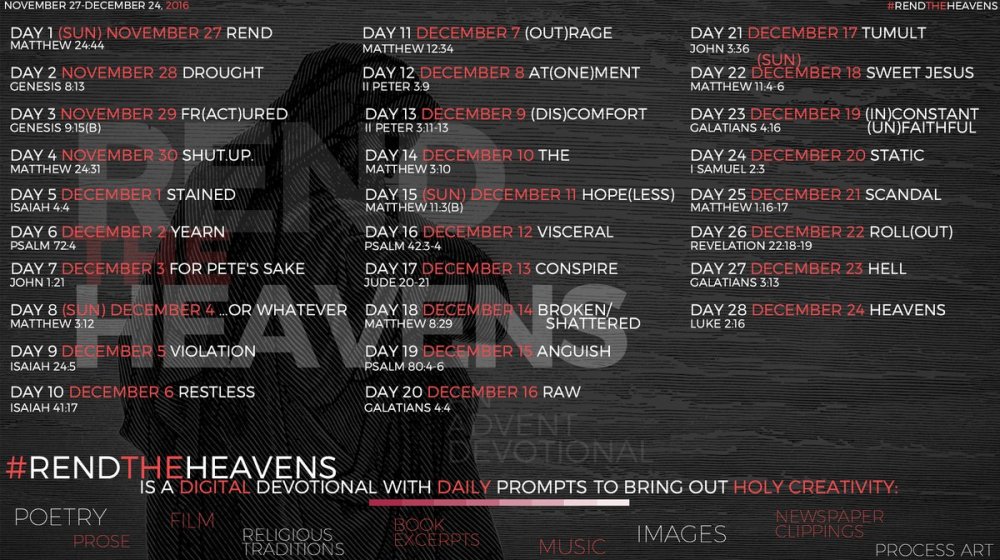
This is my Advent practice: writing every day from one of these prompts. Join me?

ct7olnmusaazqmm


Day 1: REND

Matthew 24:44: Therefore you also must be ready, for the Son of Man is coming at an unexpected hour.

Isaiah 64: O that you would tear open the heavens and come down, so that the mountains would quake at your presence

Isaiah 64, a classic Advent text, begins with the prophet begging God to rend the heavens and come down, so that the mountains would quake in God’s presence. Things had gone completely awry. “We have all become unclean,” he says, “all our righteous deeds are like a filthy cloth.” (That ‘filthy cloth,’ by the way? An ancient menstrual pad.) The holy cities had become wilderness and a desolation. The temple had been destroyed in fire, and “all our pleasant places have become ruins.” Everything, in other words, has gone to shit, and the only way Isaiah could imagine things getting better was for God to come, in might and power, tearing the heavens in two and bursting onto the scene with such inimitable control that the mountains themselves tremble when it happens.

Rend the heavens.

That’s the PG-13 version of this Advent devotional. The original compilation, created by two Lutheran priests (a tradition not unfamiliar with profanity) is called “Fuck This Shit.” I’m not squeamish about the visceral language. Neither is scripture (see: menstrual pads). I do, however, appreciate the possibilities of rending the heavens just a bit more than fucking the shit.

Rend the heavens.

I preached a mediocre sermon this morning about cosmic time and earthly time, the ways that the incarnation – Jesus, God in flesh, divine being with toenails and social anxieties – reminds us that our time is not God’s time, that the world as we experience it is not the final word in the reality game.

And there is comfort in cosmic time-telling. There is comfort in the apocalyptic advent texts that detail suffering, death and confusion, so familiar to our own. There is comfort in Isaiah’s SOS call to God. There is comfort in the possibility of another way, another truth, another time, another life.

But the comfort is not for all of us. The comfort is for those who find themselves on the underside of our worldly realities. The possibility of rent heavens is a comfort to the poor, the immigrant, the refugee, the oppressed, the mistreated, the abused. It is a comfort to the ones who, by virtue of circumstance or skin color, sexual identity or country of origin have found themselves looking at the structures of our world from the outside.

For the rest of humanity, the ones who have somehow found themselves situated at the top of the heap by virtue of nothing more than those same circumstances or skin colors or sexual identities or countries of origin, these apocalyptic texts are…terrifying.

When the heavens get rent, when God shows up, the mountains tremble. The powerful get thrown down, the rich get cast out, the ones whose lives have been relatively free of pain and suffering find themselves spun right ’round into a world that no longer makes sense, no longer protects them, no longer eases their existence.

15253517_10101451907547457_5481321959060977361_n

I am part of the rest of humanity. I am a rich, white, cisgendered, heterosexual, natural-born American citizen. Sure, yes, I am a woman, and that comes with some nasty glimpses of what it might possibly mean to live on the underside of power, but generally I am afforded every advantage in the world that I live in, the world that I assume to be the norm.

So, if the heavens get rent and God shows up and the world gets turned upside down;

If the rich are thrown out and the powerful are cast down and the temple is destroyed;

If the last become first and the first become last, if the meek inherit the earth and the poor are revealed to be God’s children…

Well, I am straight up out of luck.

This is the first year that Advent has actually felt apocalyptic to me.

That sentence is proof of my position at the top of the heap, proof of the precarious balancing act I do every day to avoid costly discipleship and retain my easy privilege.

The occurrences of these last months – a demagogue elected to leadership, black men and boys killed in spades by state-sponsored agencies, native americans barricaded and silenced and shot with freezing water as they protect the land we stole from them – these have surprised me. That this is true, that I have been surprised at the ongoing and longstanding injustices woven into the fabric of my own society: this is a luxury.

When I pray for God to rend the heavens and come quickly, when I sing the hymns of anticipation, waiting, watching and longing, when I light this candle and then the next one, I am praying for my own destruction. I am praying for my own dethroning. I am asking God to arrive here on this scene and knock me off the pedestal that was handed to me at birth and raise up all my sisters and brothers who got handed a manhole cover, instead.

img_20161127_203355912

The apocalyptic Advent texts are always unsettling. There’s talk of the sun going black and the temples being destroyed, the mountains trembling and the entire world order getting upended.

But this year, at this point in my own slow and much-too-dramatically-painful realization of my power and privilege, these texts and this season are searing. They are scalding. It feels, as Isaiah says, like fire kindling brushwood or a flame finally causing water to boil. There is fire, here, and I am getting burnt.

My prayer is that the fire is the refining kind. My prayer is that there is something of worth and value beneath all these layers of unexamined privilege and poorly-wielded power.

Because when the heavens are finally rent, I want to yell, with Isaiah: “Now, do not be exceedingly angry, O Lord, and do not remember iniquity forever. Now consider, we are ALL your people.”

arguing with the ancestors

Sermon 11-13-16

Matthew 6:1-18

I have been struggling with what sort of sermon to preach today. The election this week, and the eruption of hatred and bigotry that followed it gutted me, and I know it has done the same to many of you.

The text for this morning, here in the middle of our series on the Sermon on the Mount, is Jesus teaching against hypocrites and for humility. Do not be like the hypocrites, he intones over and over. Don’t practice your faith in order to be seen. When you give to charity, don’t sound the trumpet like the hypocrites. When you pray, don’t stand on street corners and in synagogues yelling ostentatiously like the hypocrites. When you fast, don’t make yourself all pitiful looking to get attention for your goodness like the hypocrites.

Instead, give quietly. Pray simply. Fast cheerfully.

These quiet, humble ways of being feel super insufficient this week, when hate is upping its volume to the nth degree.

Maybe you saw the news articles about the Ku Klux Klan planning a victory rally here in North Carolina. Or maybe you saw the report about the hateful graffiti that appeared on my block downtown the day after the election: Black Lives Don’t Matter and Neither Do Your Votes. Or maybe you, like me, have heard stories from friends and teachers, stories of kids being bullied and taunted, kids worried about being sent to another country because of their parents’ immigration status, kids fearing for their safety and the lives of the ones they love.

durhmam-graffitti

In the face of such escalating vitriol, such violent speech and hateful behavior, Jesus’ instructions to be humble, quiet, and not like the hypocrites feel woefully inadequate.

But, here we are.

//

I’ve been arguing with our Brethren ancestors intensely this week. The first Brethren sprang from a context of religious persecution in Germany and when they settled here in America, they spent the better part of the next century arguing over the specific kinds of engagement with the world that were or were not acceptable for followers of this Jesus who commands humility and simplicity.

Those Brethren argued for decades about the appropriateness of buttons, birthday parties, Sunday School, and musical instruments in worship. This week, I was remembering in particular the conversation that they had about whether or not voting was an activity fit for a Christian.

Can you imagine?

This week, four out of every five white evangelical Christians voted for Donald Trump for president. For whatever reason, the pollsters don’t take into account those of us Christians who aren’t white or who don’t fall into the ‘evangelical’ category, so who knows what the full picture of a ‘Christian’ demographic might be.

But the fact that the majority of white Christians voted for a particular presidential candidate and the swirl of shaming and instruction surrounding how and why Christians should vote before the election (you should see the pile of ‘voting guides’ we received in the mail here at church that I promptly recycled) makes the very idea of an extended discussion of whether or not voting could be a faithful action sound absurd.

And yet, for the majority of the 19th century, the Brethren busied themselves with this very question.

The question in 1813 was about “electioneering,” a word that I really, really love. The old Brethren were talking about participating in political elections – not just voting, but endorsing one candidate or another, one party or another. That year, according to the fascinating record called Classified Minutes of the Annual Meeting of the Church of the Brethren from 1778-1885, the gathered body had this to say:

Inasmuch as the appearance of the times into which we have come are grievous, and inasmuch as party spirit has risen so high in the kingdoms of this world that men, and even the heads of government are among themselves at variance, therefore it has been viewed in union, that it would be much better if no votes were given in at elections for such officers; for so long as there is such division of parties, we make ourselves suspicious and unpropitious on the one side, on whatever side we may vote…Moreover, is not only our land but also almost all empires engaged in war; hence it was considered best to give in no vote, else we might, perhaps, assist in electing such as would afterward oppress us with war.

Of course, like any question with real meat to it, real and immediate implications, this 1813 decision was not enough to satisfy the body. The question came again to Annual Conference in 1828. And again, in 1835. And again in 1837, 1839, 1841, 1849, 1853, 1863, 1864, 1865, 1866, 1869 and 1877. Those last few questions were in regard to the statement of 1866: “this Annual Meeting recommends to the members of the church to refrain from voting, fearing that by voting we may compromise our non-resistant principles; but we recommend forbearance toward those who vote…

It has not been easy for us, this question of how to follow Jesus in the midst of a violent world.

Those Brethren were worried about at least two things: first, given the burden of their history as a persecuted minority, they were worried that any involvement with government and society would be dangerous. This week, I have heard people who identify with various demographic minorities express that same fear – of being persecuted for simply being who they are. Better, those first, legitimately fearful Brethren thought, to keep to ourselves and practice our religion, as Jesus seems to be suggesting here in the Sermon, in secret.

Second, they were worried that voting would implicate them in the violent, oppressive systems of empire. Even in 1813, they acknowledged that all empires engage in war, and they were trying mightily not to get entangled in that situation again. They believed in the power of a Sermon on the Mount kind of life – a life of enemy love, refusal of retaliation, forgiveness and humility – to produce a faithful kind of existence, and they wanted to stay away from those tempting processes of democracy that might lure them into believing some other pathway to peace was possible.

Those Brethren believed in a Kingdom that was both bigger and more immediate than any government or empire that they might attach themselves to. Those Brethren knew, because of where they’d been and how they’d been cast out and set aside, that their first allegiance was not to a German prince or an American system, but to the Prince of Peace and Lord of Lords.

This is where I’ve been taking issue with those beloved pioneers of faith this week.

If my citizenship is in heaven, what kind of leverage do I have to speak out when my country elects leaders who are greedy, hateful, full of vengeance and intent on oppressing the orphan, the widow, the foreigner and the outcast?

If my citizenship is in heaven and I ought not put my trust in princes and mortals, how can I be grounded and present in my neighborhood where the scale needs some of us to stand on the side of justice and love in the wake of hate literally written on the walls?

If my citizenship is in heaven and I am not supposed to go pray on street corners or fast to raise awareness, what does that mean for my impulse to go join demonstrations and rallies in the public square?

//

There is an insidious danger in interpreting Jesus’ words as a license to separatism. Our beloved Brethren have a tendency to fall into that trap. If God is in control, I have heard it said this week, then we don’t really have to do anything. Once, I had a conversation with a deeply faithful man who described his take on the ecological crisis by saying “God knows what we need! If this earth gets destroyed, well, he knows everything, so he’ll just send us a new one!”

The impulse to hide away, to secret ourselves quietly into locked rooms, to stick to the known and only the known, to pretend that we are exempt from participation because our citizenship is in heaven, to hear Jesus instructing us to be not like the hypocrites and take that to mean that we ought not ever do anything outside of our own prayer closets…well, that just doesn’t make sense with the life, death, resurrection and witness of Jesus.

At the same time, the impulse to act first, pray later, to just DO SOMETHING, ANYTHING, to join in with whatever movement presents itself, to align ourselves with a party or an advocacy group, is also out of line with Jesus’ life. When we lose sight of God’s active presence, when we forget that our citizenship is first and foremost in the Kingdom and not in the American political system, when we assume that everything is always up to us and that God has nothing to do with it, we also lose our way. That, too, fails to make sense with the witness of Jesus himself.

So. Should Christians vote?

It depends.

Should Christians practice our piety in public?

Jesus warns us to beware.

I do not think that Jesus, in his Sermon on the Mount, was encouraging his hearers to pick up their lives and move into desert caves, far away from the realities of life around them. I don’t think Jesus’ warnings against hypocrisy are meant to silence us, or to keep us from speaking out boldly in his name.

I think Jesus’ words here are meant to force us to do some self-examination before we speak or act. Why is it that we are doing or saying the things we are? Are we doing it for attention? Are we doing in public things that we can’t back up with our live in private? Are we voting with the assumption that the election will bring about the Kingdom, or even part of it? Are we fasting to raise awareness of an important issue or to raise awareness of our own goodness?

Those are really difficult questions to answer. They require self-inquiry, prayer, and discernment. They require both a deep engagement with God through prayer and a deep engagement with the world through service and relationship.

I think our forebears were wrong in declaring so stridently so many things – buttons, birthday parties, Sunday school – to be absolutely not in line with following Jesus. I think we are wrong when we do that today, too. But I also believe that we need a more robust practice of prayer and discernment, larger, more gracious spaces for interrogating ourselves, our privilege, our ego.

I have been moved, this week, to be more public with my faith. I am committed to following Jesus’ commands to interrogate my own motives and to cover everything with prayer, to beware of practicing my piety in public for pleasure. I am committed to understanding what it means to put my trust in the God whose Kingdom I pray for and the Christ whose life I believe enacted a divine, salvific grace for you and for me and for every created child of God. But I am also moved to make Jesus’ messages of enemy-love, compassion, forgiveness, and care for the oppressed and the marginalized as easy to hear and encounter as those messages of hate that keep erupting.

And we are lucky, because we are already part of a community that works hard to embody that message. We are already here, we are already together, we are already blessed with the words and example of Jesus.

So. Here are a couple of things I did this week, a couple of things I’m going to invite you to join me in:

  • Our coordinating council has recently agreed to partner with Church World Service in helping to resettle refugees here in Durham. I signed up for their next volunteer training, in December. you can join me.


  • On Tuesday, I’m going to the monthly meeting of Durham Congregations in Action, an organization that brings together people of faith across lines of race and religion to work against poverty, racism and violence. One key characteristic of DCIA is that it is an organization led by people of color. In a world where I am so very often in charge as a white person, that’s important, to be in spaces where I am not. At the last DCIA meeting I went to, I heard the story of how three Durham clergy – a white Presbyterian minister, a black Baptist preacher, and a Jewish rabbi from the north – worked together to prevent the Klan from marching in downtown Durham forty years ago.


  • I downloaded the application from Brethren Mennonite Council for LGBT Interests to become an official part of their Supportive Congregations Network. This is a process of conversation and discernment toward becoming a safe space for people who do not identify as heterosexual. I think it is time for us to have this conversation.


  • You’ve noticed the messages on our sign changing. This is a tiny way to make love public. If you have ideas for the message there, share them with me.

img_20161113_134529

  • And, right here in the scripture passage is a prayer we’re probably all familiar with. We call it the Lord’s prayer, but it is the simple prayer Jesus offers in his instructions toward humility and against hypocrisy. Would you pray it now, with me?

Our Father in heaven,

hallowed be your name.

Your kingdom come. Your will be done,

on earth as it is in heaven.

Give us this day our daily bread.

And forgive us our debts, as we also have forgiven our debtors.

And do not bring us to the time of trial, but rescue us from the evil one.


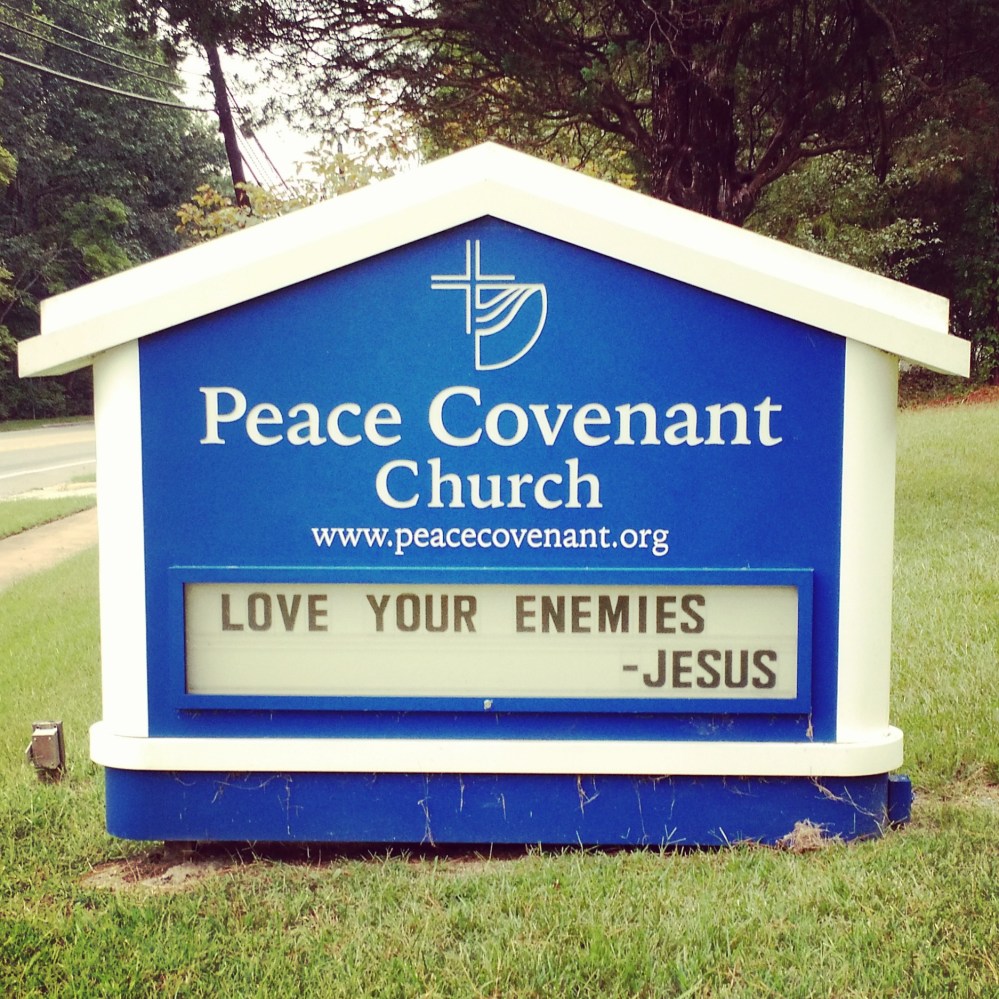
love your enemies

Sermon 11-6-16

Matthew 5:38-48

One of my favorite ‘love your enemy’ stories comes from an author and blogger named Rachel Held Evans. She is a Christian writer who identifies as evangelical but who is often pushing the boundaries of the evangelical world. Because she is a public figure with some measure of popularity in certain circles, she gets a lot of feedback on her writing. Particularly for her blogging, where people comment and email with all manner of support, question, critique and even hate.

As you might imagine, regularly receiving nasty feedback to the things you have spent time, energy, blood, sweat, tears and prayer to create is not a very pleasant feeling. Rachel shared some of the hateful emails and comments – I followed her blog for a while and saw some of them myself – and they were over the top ugly, nasty, hateful things. She was called names, banished to hell, and declared unchristian, among many much, much worse things.

A few years ago, Rachel decided after a season of prayer and discernment to find some sort of practice that would help her hold all the nasty comments in some sort of transformative way. She didn’t want to ignore all of them, but she also didn’t want to internalize them. She needed a way to receive the hatred and do something to transform it. Inspired by a Christian community who was literally changing weaponry into farm equipment, she decided to try to practice loving her enemies by printing out their emails and comments and folding them into origami peace cranes, sailboats, and pigeons.

She spent the entire season of Lent folding those nasty words into tiny shapes. Transforming her enemies’ hatred into signs and symbols of reconciliation and peace, and, in the process, softening her own heart.

One of the reasons I like this story so much is because of how simple and mundane it is. When we hear this banner statement from Jesus: LOVE YOUR ENEMIES, it can feel way, way, way too huge for anything we might be able to accomplish. It feels like Jesus might be asking us to infiltrate the Pentagon and convince all those hardened generals to send care packages instead of bombs to the Middle East.
IMG_20160925_141632.jpg

Or, even if we scale down and think about our own, very personal enemies – the people who have hurt us so deeply, the abusers or dismissers, the ones who insulted us in the way we can’t seem to forget, the friend who ended up betraying us, the partner who hurt us in such an intimate way that we can barely talk about it…well, these things also feel pretty close to impossible.

How in the world, Jesus, are we supposed to LOVE these people, when we can barely articulate the depth of the pain that they have caused us?

And that – the near-impossible feeling of it – is why this, with so much else in the Sermon on the Mount, gets relegated so often by preachers and teachers to an aspirational suggestion from Jesus and not an actual, practical way of life for his followers. It’s because it feels huge. It feels like something that is not just hard but something that might, in fact, be impossible.

That feeling doesn’t really get alleviated much by the way the passage in the Sermon on the Mount gets translated there at the end. Jesus tells us to love our enemies and pray for those who persecute us, so that we can be children of our Father in heaven. And if we only love the people who love us, well, what good is that? Be perfect, this little passage ends, as your heavenly Father is perfect.

Well, Jesus, way to set a high bar, there.

Be PERFECT?

Come on, man. We know where that train goes. Perfectionism, that feeling of never being enough, never doing enough, never quite living up to the standard…that’s no way to live.

Is that really what Jesus is teaching? That we should love our enemies because loving enemies is the way to perfection? Is Jesus setting up impossible standards and then telling us that meeting them is the only way to be loved by God?

I really, really hope not. Because I am not perfect, I’m not so great at loving my enemies, but I DO want to be a child of God. I DO want to work my way toward being a more compassionate, more loving and forgiving person who shares God’s transformative grace.

This verse has bugged me for a long, long time.

Be perfect, therefore, as your heavenly Father is perfect.

Ugh.

But in working with these texts and reading people who know Greek a lot better than I do, I found a really helpful reading.

The Greek word for ‘perfection’ in this passage is teleios. It’s related to the Hebrew word ‘tamim’ and both of these words could also be translated as ‘whole,’ ‘undivided’ or ‘complete.’

Be complete, therefore, as your heavenly Father is complete.

Hmmmm…in the context of love and who we love and how we love, this begins to make a little more sense.

Be complete in your love, therefore, as your heavenly Father is complete.

Be undivided in your love, therefore, as your heavenly Father is undivided.

Clarence Jordan, whose work on the Sermon on the Mount we’ve explored several times during these weeks, says that in this passage, Jesus is actually offering the fourth of four possibilities for how and who we choose to love.

These are what Jordan calls ‘stages’ of the law of retaliation. He traces the law through history and scripture. The first way was the way of unlimited retaliation: if someone hurt you, say they knocked out one of your eyes, you had carte blanche to do to them what they had done to you and then some. No limits to revenge. Might makes right, and whoever is in possession of the most might and power gets to have the upper hand.

The second stage is what Jordan calls limited retaliation – he traces this to the law in Exodus and Deuteronomy, and it’s what Jesus is quoting: an eye for an eye, a tooth for a tooth, a life for a life. If someone hurts you, you get to do the same back to them. Get even. Get ‘justice.’

The third stage is ‘limited love.’ Jesus is citing this stage, too, from Leviticus, when he says ‘you have heard it said love your neighbor and hate your enemy.’ Stage three creates boundaries around who deserves forgiveness and who does not – if the one who hurt you is part of your family or your neighborhood or your culture…or your race, then they deserve forgiveness. But if the one who hurt you is from outside any of those groups, well…bring in the bombers.

Jesus is doing that tri-fold riffing we talked about last week again. He’s recognizing the old traditional righteousness, describing the cycle of violence that it was meant to address, and offering a transformative solution to end the cycle.

These stages, says Jordan, were meant to curb anger, violence and retribution. But following the letter of the law – an eye for an eye or revenge only when your enemy isn’t a part of the in-group – fails to recognize the difficult cycle of violence behind the law.
img_20161106_094501

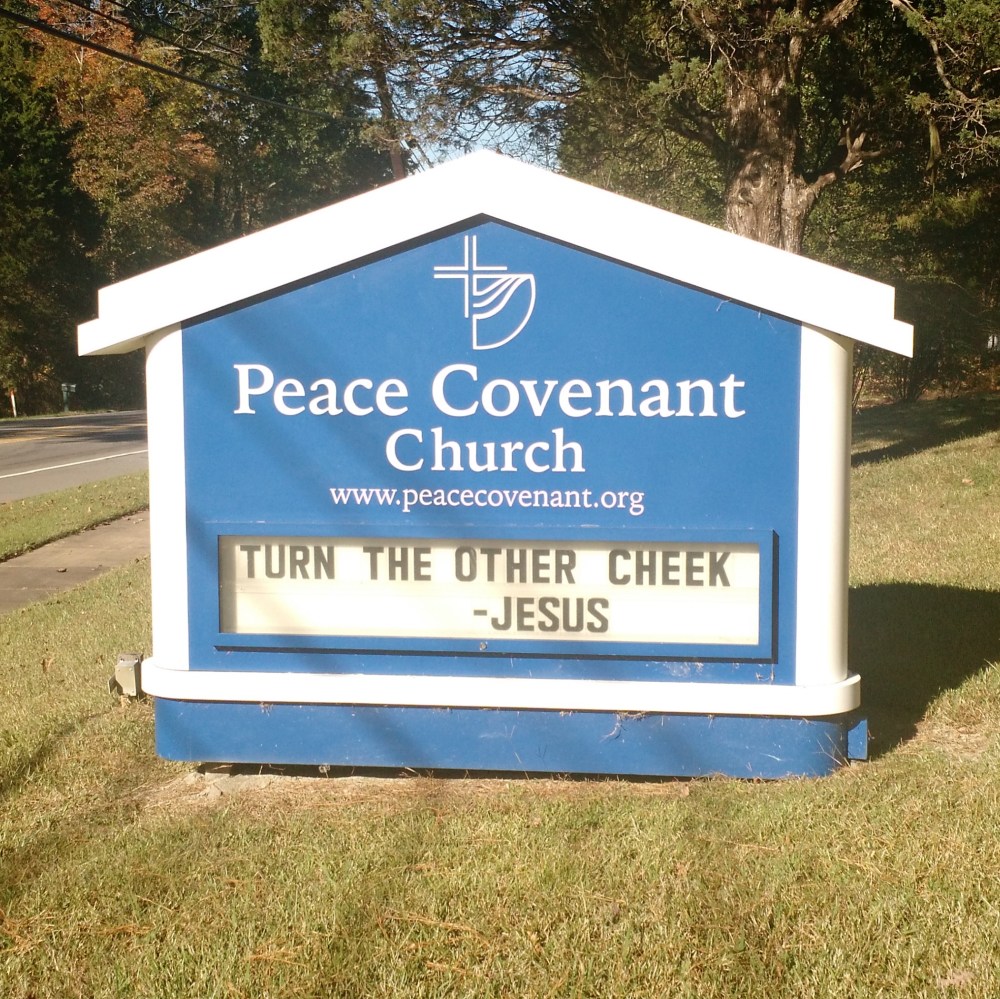
So, Jesus says: let your love be unlimited. Like God, who makes rain fall on the just and the unjust, who loves sinners and saints, who offers new birth to people like us and people very unlike us, let your love be undivided. Love your family, and your friends, and your neighbors AND ALSO all those people you thought you had permission not to love. Nope, those people are included in the sphere of love, too, as hard as it might be to imagine.

I like this four-fold process from Clarence Jordan. I like that it implies that an undivided love is not the starting point of how humans can understand God’s mercy, but that it takes us mortals a really long time – collectively as well as personally – to get there. It’s hard for us, this idea of undivided love. We want to keep ourselves safe by giving ourselves permission to hate those people who are far away, who are different, who we don’t understand, the ones we are scared of because we fear that they might hurt us.

But we just don’t get to do that. We don’t get to decide, as humans, who is and who is not worthy of love – either the love we share or the love God showers on us all. We don’t get to decide that. Jesus says: love your enemies. Do this so that your love will be as whole and undivided and complete as God’s love is.

At the end of her lenten origami practice, Rachel Held Evans reflected on the six weeks of folding hatred into signs of peace. She expected the practice to be a solitary and silent one, but she found that it became a catalyst for community. Friends sent her origami instruction books, her husband decided to learn and fold with her, friends came over to see the progress, and even her enemies – the ones who had spewed hatred on her blog and through her inbox – became a part of the process of transformation. Here’s what she said:

And in a sense, even the people who continue to hate me and call me names are a part of this beautiful process. Their words, carelessly spoken, spent the last 40 days in my home— getting creased and folded, worked over, brushed aside to make room for dinner, stepped on by a toddler, read by my sister, stained with coffee, shoved into a closet when guests arrive, blacked out, thrown away, turned into poems, and folded into sailboats and cranes and pigeons that now sit smiling at me from my office window.  

Because I am a real human being, living a very real life, with a very real capacity to be hurt, to be loved, to heal, and to forgive.  

And so are my enemies. 

And there’s the rub, isn’t it?

If we start putting boundaries around who is worthy of love – either our own or the love of the God who created us all – well, things start to get tricky really quickly.

Am I worthy of love?

Is my family worthy of love?

Are my neighbors worthy of love?

Are Cleveland Indians fans, even though they lost the World Series, worthy of love?

(I went to the VT/Duke Football game yesterday) Are Duke fans worthy of love?

Are those people who think crazy things about politics and culture worthy of love?

Is the irresponsible driver who cut me off on I-40 this morning worthy of love?

Is the guy on my block who plays spanish-language death metal to all hours of the night worthy of love?

Is the friend who betrayed me and hurt me deeply worthy of love?

Are the churches who don’t think I should be in ministry because I’m a woman  – and told me so – worthy of love?

Is the woman wearing the t-shirt that says Hillary for Prison worthy of love?

Is the man wearing the hat that calls Donald Trump a nasty, nasty name worthy of love?

Is the man who killed two Des Moines police officers in a horrific, ambush-style killing this week worthy of love?

Are the members of Boko Haram, who abducted our sister Gloria and kidnapped, killed and displaced so many others, worthy of love?

We might learn from our sisters and brothers in Nigeria, who have said and continue to say explicitly that they are praying for Boko Haram. After a trauma healing workshop this summer, one girl who had been kidnapped said: “When we fled from Boko Haram, I prayed that God would never forgive them. Now I will pray that God will forgive Boko Haram.”

“You have heard it said,” Jesus preaches, that there can be limits to love. You have heard it said that an eye for an eye and a tooth for a tooth is a sensible way to live, and indeed, it works out okay when we are able to limit our retaliation and institute some sense of justice.

But I say to you: God’s love is without borders, without divisions, without limits.

So, you who have received this whole, complete, undivided kind of love: love your enemies. Pray for those who persecute you. Give to anyone who begs of you. Recognize that even the one who hurt you, even the one of whom you are deeply afraid, even the one who seems irredeemable and completely lost: even these are not outside the realm of worthiness.

Let your love be whole. Be my children. Love without limits.


Pastoral Prayer

God whose love is larger than we can imagine,

Be near to us this morning, near to us in our joy and near to us in our pain. You know the shape of our lives, the broad strokes and the smallest details, and you love us thoroughly. Open our hearts to that immense love.

These are days of disagreement and contention, God of Love. Our country is struggling to practice its own politics with grace, struggling to hear and listen to the experiences of people who are not like us, struggling to find a way forward where everyone might find paths to an abundant, flourishing kind of life.

It is easy to lose ourselves in the vitriol, in the polling statistics, in the campaign rhetoric. Open our ears to your word, God of Love. Help us to hear, above the din of argument and anger, your call for our own love to be as undivided as yours. Help us to heed your instruction to love our enemies, to pray for those who persecute us, to give to any who ask of us.

Rearrange our brain chemistry, God, so that we might see each of your beloved children not as Democrat or Republican, not as nasty women or deplorable beings, not as percentages or demographics, not as enemy or ally, but as a precious being, a sister or brother, a whole human with a story as whole and complicated as our own, created by you, sustained by your living breath, and worthy of care, attention, respect and yes, even love.

If we are your children, we are entrusted with this great gift: to be a living example of your huge, whole, all-encompassing and boundary-defying love. Give us the humility and the courage to be who we are, God of undivided love.

There are many among us who are in need of that huge love this morning, God, and we lift them up and hold them in the light of your care:

And, there is much to celebrate this morning, too, and these we lift up to you with equal care:

All of this we pray in the name of Jesus, the one who taught us that ‘enemy’ is a false category and that it is your love that demolishes all divisions, Amen.



the lowdown

The lowdown:

SNAP benefits are $4.20 per person per day in North Carolina. The challenge lasts 5 days, my household is 1 person, so $4.20 x 5 = $21.00 for the week’s food budget.

I have a little experience planning and cooking on small food budgets from my time spent in Brethren Volunteer Service and living in intentional community. I have a repertoire of cheap and relatively easy meals: beans and rice, lentils, eggs, lots and lots of potatoes.

In the BVS house where I lived, we had housemates who were vegetarian AND gluten free, and we ate on $3/day. There were 9 of us in that house, though, so the pennies stretched a lot farther. The cooking had to be creative to accommodate diets, but we almost never had a problem with affording enough to feed us all.

Cooking on a budget gets a lot harder when you’re doing it alone, though. $21 is not very much money.

I usually shop at the Target superstore, ten minutes from my house. My neighborhood is something of a food desert – there is a supermarket on the corner called Los Primos, but I have yet to gather enough courage to check it out. There are bars on the windows, people always loitering in the parking lot, and the big banners advertising their prices are mostly for cheap soft drinks. One of my goals this week was to walk over and explore the neighborhood grocery, but I confess that it did not happen.

The next closest grocery stores are Harris Teeter and Whole Foods, both about 3 miles away and both with sky-high prices.

In terms of groceries accessible to someone without their own car, in my neighborhood it’s either Los Primos (renewing my commitment to walk over later today) or the various convenience stores scattered across street corners.

Target is the cheapest of those stores, but even Target’s prices aren’t low enough to make eating on $4/day possible. So, I drove all the way to the other side of town, to Aldi – 13 miles away.

Aldi has rock bottom prices. I got *almost* everything on my list for $20 even. I forgot, though, that Aldi is able to keep their prices so low because of the little tricks they do to keep overhead low: no bags, no bagger, pay a quarter to get a cart. I forgot both a quarter and my bags. Luckily, as soon as I got out of my car, a kind woman gave me her cart, quarter-free. I did end up having to buy a bag, though, in order to get everything from the cart to my car and my car to my apartment, which tacked on $2 to my total bill.


meal planning // 12 mile journey to Aldi // $20 on the nose


So. I’d spent $18 on food, and still needed coconut milk, regular milk, and tahini for the homemade hummus plan. I drove back across town to the Food Lion by Duke – cheaper than either Harris Teeter or Whole Foods – and spent another $2.29 for milk, $4.18 for 2 cans of coconut milk and a whopping $7.29 for a bottle of tahini. $13.76. Adding that to the $18 Aldi expense, I’d already spent $31.76 for the week, $10 over budget before I even began.

However.

I shared my meals with three other people on Monday alone, which I think might make up for $3 of that overage.

$7 over budget.

And, I have filled my fridge and freezer with leftovers. The food I made will easily feed me and/or others for 7 more meals, beyond this week.

The challenge is manufactured, of course. That $31 didn’t include all the pantry staples I’ve taken advantage of over the course of this week, and I also had plenty of money in my checking account to buy all the other essentials I needed – toilet paper, gas for my car, dog food, new socks and dishwasher detergent. Going over budget on my grocery shopping trip didn’t affect any of my other financial needs this week, unlike someone whose checking account has many fewer expendable dollars. I have so many stopgaps that are inaccessible to people qualifying for SNAP.

It’s the tiny, taken-for-granted things that I am forced to appreciate this week: access to reliable transportation, a cupboard full of sugar, flour, peanut butter and dried fruit, a no-fee checking account, the layer upon layer of safety netting piled under me – friends, family, quality insurance, middle-class privilege, etc., etc., etc.

This challenge is manufactured – I don’t need SNAP benefits, and I’m not even entirely relying on them this week. But it is also allowing me to see my life incrementally more as it actually is, to acknowledge my privilege and begin to think about ways to own, leverage, and use it for good.

pb&banana oats // lentil curry…AGAIN // date night = CHEESEBURGER (almost as excited about getting to eat off a PLATE)

concerning self-deception

I was hungry yesterday. No, actually, I was HANGRY.

Every day this week, I’ve had stomach rumblings around 3pm, that wide gulf of lethargic afternoon between the small lunch portion and the small dinner portion. I filled the gaps on Monday and Tuesday with snacks I found in my pantry – peanuts and dried fruit, the last slice of the banana bread I made. But yesterday, I’d finished off the bread and fruit and snuck peanuts for a morning snack already, and was determined to stick it out.

And you guys, I was such a crab. Fran and I had gone for a long hike in the morning (well, as long a hike as a 7lb chihuahua can endure – she conks out between 3 and 4 miles), and my body was craving calories and protein.

The squash soup and apple I ate for lunch were delicious, but they were lacking in protein. I desperately wanted a cheeseburger. I seriously considered jettisoning the entire endeavor, getting in my car and driving to the nearest fast food establishment to satiate myself.

Instead, I groused, I grumbled, I snarked about it on Facebook. I ate my dinner of lentil curry at 5pm on the dot in order to staunch the cravings. It worked, sort of. I still went to bed early, cranky and hungry.

I was hungry, yes. But I suspect that the hanger – the annoyance, anger and snark – had more to do with my previously unlimited food choices being so sharply curtailed.

In my life, when I want something to eat – a cheeseburger, a pizza, a salad full of berries and goat cheese – I simply get in my car, drive to a place that sells it, give them some money, and I get what I want. Sometimes, I sit on my couch in my pajamas, click a couple keys on my computer and whatever it is I want shows up at my doorstep, like magic.

Not being able to get what I wanted when I wanted it made me really, really cranky.

I am super uncomfortable with this reality.

My image of myself is pretty low-maintenance. I am a simple-living Brethren clergy person, an alumnus of Brethren Volunteer Service who lived in a community house, ate on $3/day and shared a single van with eight other volunteers for transportation! I have the chops! I have the simple-living cred! I know how to do all of this already!

Except, of course, having the cred and the chops is not the same as living it day in and day out. I’m starting a sermon series on Jesus’ Sermon on the Mount, which is where the Son of God himself says that the phonies who pretend to follow him but never actually DO the things he teaches will be denied entrance into the Kingdom of Heaven, cast aside as he declares “I never knew you! Go away from me, you evil ones!” That section, in Matthew 7, wins the subheading of ‘Concerning Self-Deception.’

And, ugh. Self-deception suuuuuuucks, you guys. I assumed that I had the resources – both recipe-wise and chutzpah-wise to take on this challenge with no problems. I knew the budget was small and that I’d probably feel hungry a bit, but I figured that I could hit up my network of simple-living friends for good recipes and pray a little more to get through a few moments of discomfort. Turns out, being denied my every wish and whim is a little harder to stomach than I thought.

It really isn’t the food that’s hard. What I’m eating is nourishing, tasty, and probably exponentially healthier than my usual diet. There’s no meat, but I could easily see ways to insert more protein and even begin – once I started stocking my freezer with leftovers – to afford some frozen chicken to supplement the beans and lentils.

What’s hard is the butt-kicking realization that I operate each and every day with the assumption that I can get whatever I want, that my desires can and should be immediately satisfied, that I am entitled to eat and drink all manner of luxurious, earth-abusing, wallet-thieving, neighbor-ignoring, body-denying things JUST BECAUSE I WANT TO.

Well.

That’s not okay.

What I eat affects my body, yes, but also my neighbors and my planet. I’ll be making a sizable donation to the CROP walk at the end of this week – the balance of what I usually spend on food and the tally of all the times I’ve cheated on the challenge over the course of this week. Eating the way I do is, in effect, hoarding my resources. It is selfish. It is like building a bigger barn (Luke 12!) with my own flesh.

So. When the challenge is over, I’m totally eating a cheeseburger. But then, I’m also going to pay some serious attention to the ways I spend and eat. And I’m going to inspect my charitable giving and see what can happen there, too.

Because I do not want to continue living in such a self-deceived way. I don’t want to be such a slave to my own desires.


SNAPchallenge: where we eat only from bowls

winning the oatmeal game with pb&banana // still working the vat of squash soup // spicy lentil curry & a bonus quesadilla

the agony of $5.21

Every Tuesday evening, I have “office” hours at a local coffee shop from 5:30-7:30. I also have an appointment with my therapist (every pastor needs one, y’all – caregivers need caregiving) every other Tuesday from 3-4. Both are on the opposite side of town from my house, so I usually fill that hour with a labyrinth walk (at an Episcopal church around the corner from the therapist’s office) and a quick dinner somewhere. Then, I usually grab coffee and dessert at office hours, because they make pie. Delicious, delectable pie.

This was not a therapy week, so I had time to cook dinner before heading to office hours. And dinner – Red Lentil Curry from the Simply In Season cookbook – was a HIT. Spicy, full of veggies and protein, and super easy to make. I downed a bowl before heading out the door.

I’d debated whether or not to buy anything at the coffee shop, since it’s clearly outside the SNAP budget parameters, but I LIKE those guys (Bean Traders Coffee). I like that my office hours support their local business that pays a living wage and has pointedly gender-neutral bathrooms in the heart of a state still arguing about HB2.

So, I decided to go with my regular routine and add the cost to my CROP donation. Coffee and a coconut brownie ran me $5.21.

$5.21.

That’s more than an entire day’s food budget, for completely unnecessary sugar, fat and caffeine.

And I do that every week, y’all.

This is the divide I come up against every time I begin to think seriously about how I eat: is it nourishing my body or is it nourishing my relationships?

It’s an unfair question, of course. Food can nourish bodies and relationships – I think that’s one of the most beautiful things about it. In church, we take communion and practice the Love Feast because we know, deep down, that eating together creates stronger bonds and deeper intimacies.

That $5.21 contributed to my pastoral availability. That weekly expense allows me to be out in the community, available to my people in a casual, non-threatening kind of way. I have had intense conversations at coffee hours – conversations of joy and grief and spirituality, discussions about hopes and dreams for our congregation, stories of spiritual wounds and tales of redemption have been shared there.

And, of course, that $5 every week also keeps people employed in good, living-wage jobs in a good, fair employment situation.

But $5 could have bought 5 dozen eggs or 2.5 giant canisters of oats or 6 cans of black beans. That’s so much protein – a thing which I am sorely missing this week!

It’s a middle class privilege to do this kind of agonizing over $5. And it’s a middle class privilege not to have to do it every week. I have never thought about those $5 before now, the value of what they buy, whether or not they could be put to better use. But I promise you, next week’s $5 expenditure will feel different.

The oatmeal game is slowly improving. Yesterday was cocoa oats and banana bread for breakfast, disgusting .99/dozen Aldi scrambled eggs (Seriously, they were AWFUL. Farmer’s market eggs from now on.) and toast for lunch, aforementioned lentil curry for dinner and a couple of cheater snacks in between.

I am missing meat. I am missing protein.


as freely as you have received

“A Christians dealing with human hurts, we have to remind ourselves again and again that we are not called to be successful, but to be faithful. Our first directions come from the way Jesus told us to live, not from what we think will work.”

That’s Doris Janzen Longacre, writing a theology of FOOD in the classic Mennonite cookbook, More with Less.

More with Less was published in 1976, when the Mennonite Central Committee asked every Mennonite household to cut its annual food budget by 10% in order to live more simply and share more generously.

40 years later, her words carry even more insistence – while there are 200 million fewer hungry people in the world today, huge progress toward the UN’s Millennium Development Goal of cutting the numbers of hungry people in half – the ways we eat here in America are still filled with processed, nutrient-poor fast and convenience food.

I know that I treat food as convenience more often than I recognize it as nourishment. I live alone and work from home, so food is often a good reason to get out of the house – I’ll walk downtown for lunch, take my laptop to the coffee shop for a latte and pastry while I work. I meet people over meals or coffee because that’s the easiest and least intimidating way to schedule a pastoral visit.

Because I’m a single person, meals often become drive-by, drive-through experiences. It seems ridiculous to simmer something on the stove all day long when I’ll be the only one eating it. It’s hard to do home-cooked single servings, but the pre-packaged salads at Target (strawberries and goat cheese!) and the (mouthwatering) al pastor from the ever-present taco truck in my neighborhood are perfect for solo mealtimes.

But neither of those fit the $4/day SNAP budget. In fact, the budget doesn’t even make room for a single, regular coffee outside my own house. So, this week, I’m cooking big batches and – with Longacre’s words ringing in my head and reminding me of all the times Jesus told us to give, share and offer what we have – figuring out how to share both the food and the time.

Yesterday was the first day of the challenge. I’ll write later about how the meal planning and shopping went over the weekend (annoyingly, to say the least), but here’s a report from Day 1:

A gigantic container of quick-cook oats was $2 at Aldi, and Good & Cheap has a four page spread of interesting ways to cook oats, so oatmeal for breakfast it shall be this week. Yesterday was a trial run: regular oats jazzed up with apples, cinnamon and brown sugar. It was….bland.

BUT. My boyfriend was here, after a horrendous day of saying an unexpected and heart-wrenching goodbye to his beloved dog, Isaiah, on Sunday, and so I got to share the very first meal of the challenge with him.

That sharing turned out to set the tone for the day, too. I had butternut squash from one friend and a soup recipe from another, and planned to make that for dinner. While the soup simmered, I remembered gifted bananas, too, and whipped them right up into some banana bread. I had plans to visit a church friend recovering from surgery in the afternoon, and wanted to take some comfort food along, so after I ate my own serving, I wrapped up half the loaf and a tupperware full of the soup and took it with me.

It was so satisfying to be able to feed sad and sick friends, even on a tiny budget.

I have a standing Sunday potluck dinner date with my friend Lauree, but Sunday’s schedule got a little wonky, so we switched our dinner to Monday. I was uncertain what I’d be able to contribute on such a small budget, but even after eating and sharing the soup for lunch I still had SO MUCH, that I took soup and banana bread to dinner, too.

I told Lauree about the Challenge, and joked that the potluck meal would be totally blowing the budget, and that I’d have to explain the photos when people saw how richly I was eating. Her response, though, was “What do you mean? I didn’t spend ANY money on this food!”

And, you guys, other than pantry staples, it was kind of true. Lauree grew up on a farm, and her entire yard – front, side and back – is like a Garden of Eden. She grows everything imaginable, including both fig and persimmon trees (the epitome of luxury, it seems to me, not to mention the biblical resonance with Micah 4:4). She had made a soup with mushrooms she’d harvested from her incredible front yard garden, cooked up some homegrown squash and slathered it with the delicious fig jam she makes from her own fig trees. We did have wine, but it was from Aldi – $5/bottle. No breaking the budget, here.

So. Here’s the barely processed lesson of Day 1: Our first directions come from the way Jesus told us to live, not from what we think will work.

I did not think that this budget would work. I still don’t. In fact, I got hungry yesterday afternoon and cheated by eating snacks I found in my pantry, not included in the budget shopping. But as it turns out, sharing what I have makes things so much easier. I discovered that the soup I had hoped to last only me for three or four lunches is going to do that AND so much more.

I suppose, technically, sharing my food would expand my budget. I ate with another person at each meal yesterday, so I think that could legitimately up my weekly allowance another $3, which would easily cover my afternoon snack.

“Give to all those who ask of you,” Jesus says. “Give as freely as you have received.” “Give, and it will be given to you.” Okay, okay, Jesus. It’s making some sense.


DAY 1:

oatmeal // soup&bread // afternoon cheater snack // mushroom soup&bread&squash&fig&pickles&wine

SNAP Challenge

Last year, I spent an average of $302 on food each month.

That’s probably a bit off, since it doesn’t take into account anytime I used cash to buy coffee, pie, or fast food. It doesn’t include all the weeks I was traveling for work and had my food provided, either. It’s probably closer to $350 or $400 per month.

That’s a lot of money.

I was marginally employed for half of last year, so $350/month varied from 9% to 35% of my income.

That’s right in line with the average – in 2013, the average American spent 9.9% of their income on food. But my food expenditures last year mirror more than the average: that 2013 study (http://www.npr.org/sections/thesalt/2015/03/02/389578089/your-grandparents-spent-more-of-their-money-on-food-than-you-do) breaks the population down into income brackets: those making the least money spent 36% of their income on food.

Huh.

Food needs don’t change that much whether you make $10,000 or $45,000 a year. Everybody needs to eat.

Everybody needs to eat, but not everybody can afford to do it very well. One in every nine people in the world doesn’t get enough to eat on any given day. In the U.S., 14% of the population is food insecure, and in North Carolina – where I live – the number is 17%. Here in Durham, those food insecure people include 27% of our county’s children.

The SNAP challenge has been around for a while. You might have heard about it. SNAP is the Supplemental Nutrition Assistance Program, the program formerly known as ‘food stamps.’ As of July 2016, 43 million Americans participated in the SNAP program. In North Carolina, the SNAP allocation is $4.20 per person per day. The ‘challenge’ is to those of us whose income provides sufficient funds to use on food and don’t need the benefit. For one week, we’re challenged to eat on a SNAP budget.

$4.20 per day would add up to $29.40 each week, or $117.60 each month. That’s a third of what I am accustomed to spending on food.

My sister, who spent the last eight years working for Roanoke County as a benefits specialist, helping people take part in SNAP and other government programs, reminds me that SNAP is not actually meant to be a family’s entire food budget. It is meant, just like the name implies, to SUPPLEMENT a household income, so that food expenses don’t sink the perilously balanced ship that is the budget of a family in or near poverty.

And, as long as we’re pointing out inconsistencies with the challenge, friends who have lived in and near poverty remind me that even doing this as a ‘challenge’ implies a certain level of food security. My boyfriend, who saw lean years as a church planter and ate on less than this out of necessity, was distinctly non-plussed when I asked if he was interested in participating with me.

Friends who’ve experienced poverty also remind me that dollars and cents do not actually tell the whole story. In places where no one has enough on their own, people share food and people share meals. The $4.20 per person per day does not take into account the generosity of neighbors and strangers, the ways that cooking for larger groups can cut down costs, the simple, everyday sharing economy that nourishes relationships as well as bodies.

Nonetheless, I’m taking the challenge. I’ve done the planning, the shopping and a bit of the meal preparation for the week. It’s only Monday morning, and already things have gone all wonky with unexpected schedule changes and budget constraints. We’ll see how this goes.

The idea behind the SNAP challenge here in Durham is that for five days, I’ll attempt to eat on $4.20 per day. I’ll donate the rest of the money that I would have otherwise been spending on food to the local CROP walk, which fights hunger here and around the world. And I’ll be blogging, instagramming and snap chatting all week long.

Join me, y’all.